International Symposium on Algorithmic Game Theory (SAGT) 2026

The 19th International Symposium on Algorithmic Game Theory (SAGT) will be held at the University of Augsburg, Germany, on 15-18 September 2026. A Pre-SAGT workshop on Mechanisms with Predictions will be held from 14-15 September 2026, directly before the conference (see details below).
The purpose of SAGT is to bring together researchers from Computer Science, Economics, Mathematics, Operations Research, and related fields to present and discuss original research at the intersection of Algorithms and Game Theory.
Foundational work is solicited on topics including but not limited to:
• Solution Concepts in Game Theory
For all participants, we recommend to start booking the trip early as hotel prices in Augsburg will rise quickly due to Munich Oktoberfest, which starts right after SAGT 2026 ends. Please see the timeline below as an orientation for booking your trip to Augsburg.
Timeline:
14 Sep 2026, noon: Start of the Pre-SAGT Workshop
15 Sep 2026, late afternoon: End of the Pre-SAGT Workshop15 Sep 2026, evening: SAGT 2026 Welcome Reception with SAGT Pub Quiz
16 - 18 Sep 2026: SAGT 2026 main conference
16 Sep 2026, late afternoon: SAGT 2026 Poster Session preceeded by lightning talks
17 Sep 2026, evening: SAGT 2026 conference dinner
18 Sep 2026, early afternoon: End of SAGT 2026 main conference
Call for Participation: Registration is open!

Latest News
All times are CEST.
| Monday | 14 Sep 2026 | |
|---|---|
| 13:00 -- 14:00 | Workshop Registration + Lunch |
| 14:00 -- 15:30 | Workshop Lecture 1 |
| 15:30 -- 16:00 | Coffee |
| 16:00 -- 17:30 | Workshop Exercises + Discussion 1 |
| 19:00 | Workshop Dinner (self paid) |
| Tuesday | 15 Sep 2026 | |
| 09:00 -- 10:30 | Workshop Lecture 2 |
| 10:30 -- 11:00 | Coffee |
| 11:00 -- 12:30 | Workshop Exercises + Discussion 2 |
| 12:30 -- 13:30 | Lunch |
| 13:30 -- 15:00 | Workshop Lecture 3 |
| 15:00 -- 15:30 | Coffee |
| 15:30 -- 17:00 | Workshop Exercises + Discussion 3 |
| 17:00 -- 18:00 | SAGT Registration + Coffee |
| 18:00 -- 18:10 | SAGT Opening |
| 18:10 -- 19:30 | SAGT Welcome Reception |
| 19:30 -- 22:00 | SAGT Pub Quiz |
| Wednesday | 16 Sep 2026 | |
| 09:30 -- 10:45 | Invited Talk: Beyond Monotonicity: Learning in Bayesian Games Martin Bichler |
| 10:45 -- 11:15 | Coffee |
| 11:15 -- 12:30 |
Paper Talks (3 × 20 minutes) Stability in Combinatorial Markets with Side Payments. Alexander Grosz and Chiara Vanoli Perpetually Fair Assignments Via Balanced Sequences of Permutations. Terrence Adams and Erel Segal-Halevi Distributed Agent-Constrained Truthful Facility Location. Argyrios Deligkas, Panagiotis Kanellopoulos and Alexandros Voudouris |
| 12:30 -- 14:00 | Lunch |
| 14:00 -- 15:15 |
Paper Talks (3 × 20 minutes) Minimizing Cumulative Envy in Allocating a Sequence of Items. Paul Goldberg, Isaac Robinson and Nicholas Teh Distributionally Robust Contract Design with Deferred Inspection. Halil Ibrahim Bayrak and Martin Bichler On the Power of Deception in Repeated Games. Melissa Dutz, Dimitar Chakarov, Saba Ahmadi and Avrim Blum |
| 15:15 -- 15:45 | Coffee |
| 15:45 -- 16:15 |
Poster Lightning Talks (14 x 2 minutes) Support Collapse from Entropic First-Order Stationarity in First-Price Auctions. Philip Hierhager |
| 16:15 -- 17:15 | Poster Session |
| 17:15 -- 18:00 |
Paper Talks (2 × 20 minutes) Computing Fair and Efficient Indivisible Chore Allocations with Bounded Surplus. Nicholas Teh Network Allocation Games with Anonymous Preferences. Argyrios Deligkas, Eduard Eiben, Šimon Schierreich and Alexandros Voudouris |
| 18:15 | Hike + Dinner at a nearby Beer Garden (self paid) |
| Thursday | 17 Sep 2026 | |
| 09:00 -- 10:15 |
Paper Talks (3 × 20 minutes) Temporal Fair Division of Indivisible Goods with Structured Constraints. Kui-Wang Choi and Minming Li Robustness of Persuasion to Receiver Preferences. Ronen Gradwohl, Fengming Hu and Rann Smorodinsky Improved Lower Bounds and Output Augmentation for Facility Location Mechanisms. Rafael Gomes, Sophie Klumper, Guido Schäfer and Jens Schlöter |
| 10:15 -- 10:35 | Coffee Break |
| 10:35 -- 11:50 |
Paper Talks (3 × 20 minutes) Simultaneous Ordinal Maximin Share and Envy-Based Guarantees. Timo Reichert and Hannaneh Akrami Single-Agent Stability in Additively Separable Hedonic Games with Constrained Coalition Sizes. Martin Bullinger, Adam Dunajski, Edith Elkind and Matan Gilboa Control and Bribery in Stable Marriage and Roommates: A Complete Complexity Landscape. Jiehua Chen and Ildikó Schlotter |
| 11:50 -- 13:00 | Lunch |
| 13:00 -- 14:15 |
Paper Talks (3 × 20 minutes) Fair Division with Binary Valuations: Characterizations. Florian Brandl, Warut Suksompong and Nicholas Teh Bribery’s Influence on Ranked Aggregation. Pallavi Jain and Anshul Thakur Individual Rationality in Constrained Hedonic Games: Friends, Enemies, and Neutrals. Šimon Schierreich and Ildikó Schlotter |
| 14:15 -- 14:35 | Coffee |
| 14:35 -- 15:50 |
Paper Talks (3 × 20 minutes) Improved Approximation Guarantees for Groupwise Maximin Share Fairness. Georgios Amanatidis, Anna Korfiati, Evangelos Markakis and Christodoulos Santorinaios Nucleolus Computation by Non-Zero-Constrained Optimization. Daniel Ebert and Antonia Ellerbrock Hospitals/Residents with Inseparable Couples: Finding a Coalition-Stable Assignment Is NP-Hard. Zeyuan Hu and Greg Plaxton |
| 15:50 -- 16:10 | Coffee |
| 16:10 -- 17:25 | Invited Talk: EIP-1559: A Five-Year Retrospective Tim Roughgarden |
| 18:30 -- 19:30 | Guided Augsburg City Tour |
| 19:30 -- 23:00 | SAGT Conference Dinner |
| Friday | 18 Sep 2026 | |
| 09:00 -- 10:15 | Invited Talk: When It's All Relative: Equilibria and Efficiency in Rank-Based Games Tami Tamir |
| 10:15 -- 10:35 | Coffee |
| 10:35 -- 11:50 |
Paper Talks (3 × 20 minutes) Leveraging Matchings in Constrained Fair Division with a Conflict Graph. Evangelos Markakis and Michalis Samaris Realist Vampire(s) Seeking Consenting Suicidal Person(s). Fabien Mathieu Complexity of Eliminating (Majority) Illusion in Directed Networks. Sougata Jana and Sanjukta Roy |
| 11:50 -- 13:00 | Lunch |
| 13:00 -- 14:15 |
Best Paper Talks + Business Meeting + Closing Best Paper: Extension of Excess Demand Ascending Auction to Multi-Demand Model by Discrete Convex Analysis Approach. Kazuo Murota and Akiyoshi Shioura Best Paper: Efficiently Restructuring Sovereign Debt via Arctic Auctions with Convex Costs. Jugal Garg, Edwin Lock and Vijay Vazirani |
For all participants, we recommend to already start booking the trip as hotel prices in Augsburg will rise quickly due to Munich Oktoberfest, which starts right after SAGT 2026 ends. Please see the timeline below as an orientation for booking your trip to Augsburg.
Timeline:
14 Sep 2026, noon: Start of the Pre-SAGT Workshop
15 Sep 2026, late afternoon: End of the Pre-SAGT Workshop15 Sep 2026, evening: SAGT 2026 Welcome Reception with SAGT Pub Quiz
16 - 18 Sep 2026: SAGT 2026 main conference
16 Sep 2026, evening: SAGT 2026 Poster Session preceeded by lightning talks
17 Sep 2026, evening: SAGT 2026 conference dinner
18 Sep 2026, early afternoon: End of SAGT 2026 main conference
Register now
Early-Registration ends on 26 August 2026.
SAGT 2026 will include a poster session where participants can present posters of preliminary working papers as well as papers accepted at SAGT 2026 or previously published at other conferences. We plan to have short lightning talks (3 minutes per poster) to introduce the posters.
Posters will be displayed at the conference venue throughout the event, from the afternoon of Sep 16 to Sep 18. A dedicated poster session (preceded by the lightning talks) on Wed Sep 16 will be included in the program.
Submission of posters will be open for all participants, and we will conduct a basic quality check to verify that accepted posters will contain interesting and relevant information.
If you wish to present a poster, register for the conference and send us your poster via email to: SAGT2026@informatik.uni-augsburg.de
Poster submission deadline: 07 September 2026
The Program Committee decided on two SAGT 2026 Best Paper Awards.
The following posters got the SAGT 2026 Best Poster Award:
- Simultaneous Ordinal Maximin Share and Envy-Based Guarantees, Timo Reichert
- Heterogeneous Routing Games, Nicole Schröder
- Realist Vampire(s) Seeking Consenting Suicidal Person(s), Fabien Mathieu
Congratulations!
The following talks got the SAGT 2026 Best Presentation Awards:
- Stability in Combinatorial Markets with Side Payments. Chiara Vanoli
- Improved Lower Bounds and Output Augmentation for Facility Location Mechanisms. Rafael Gomes
Congratulations!

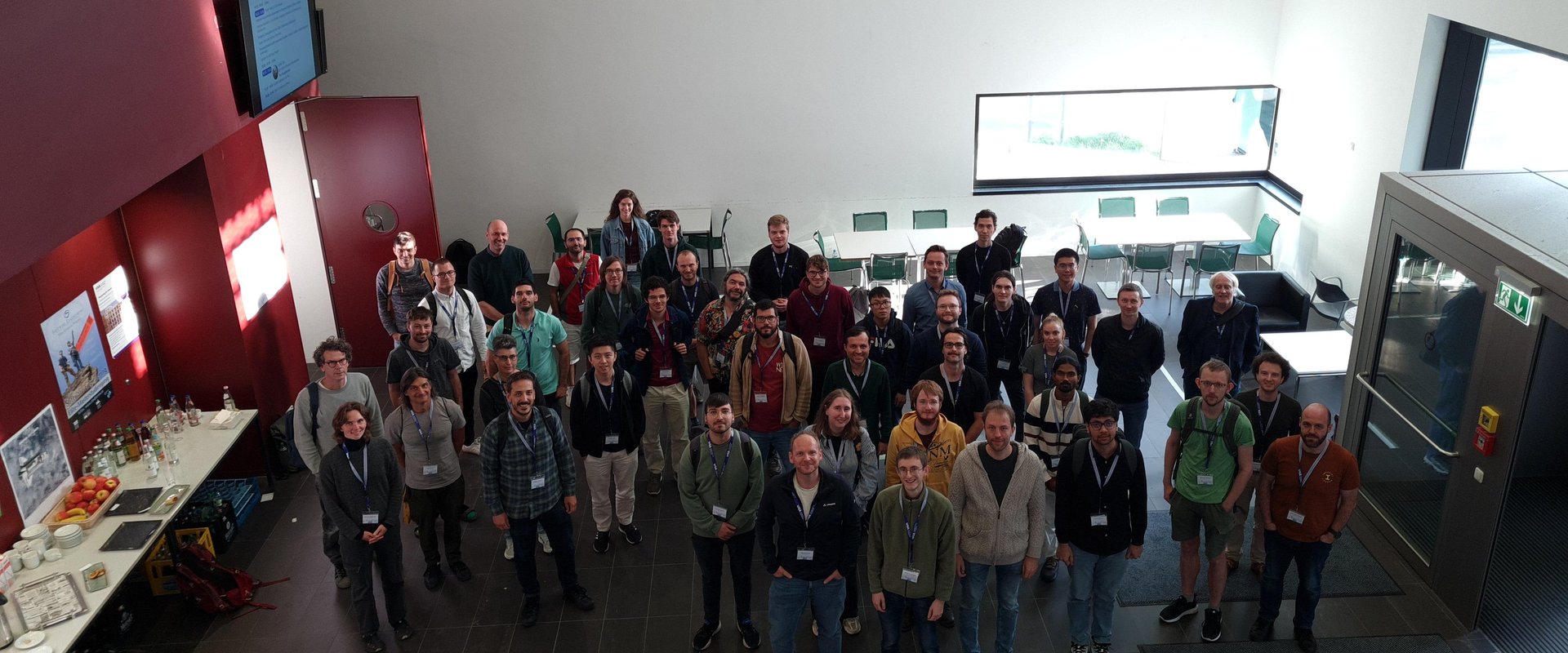
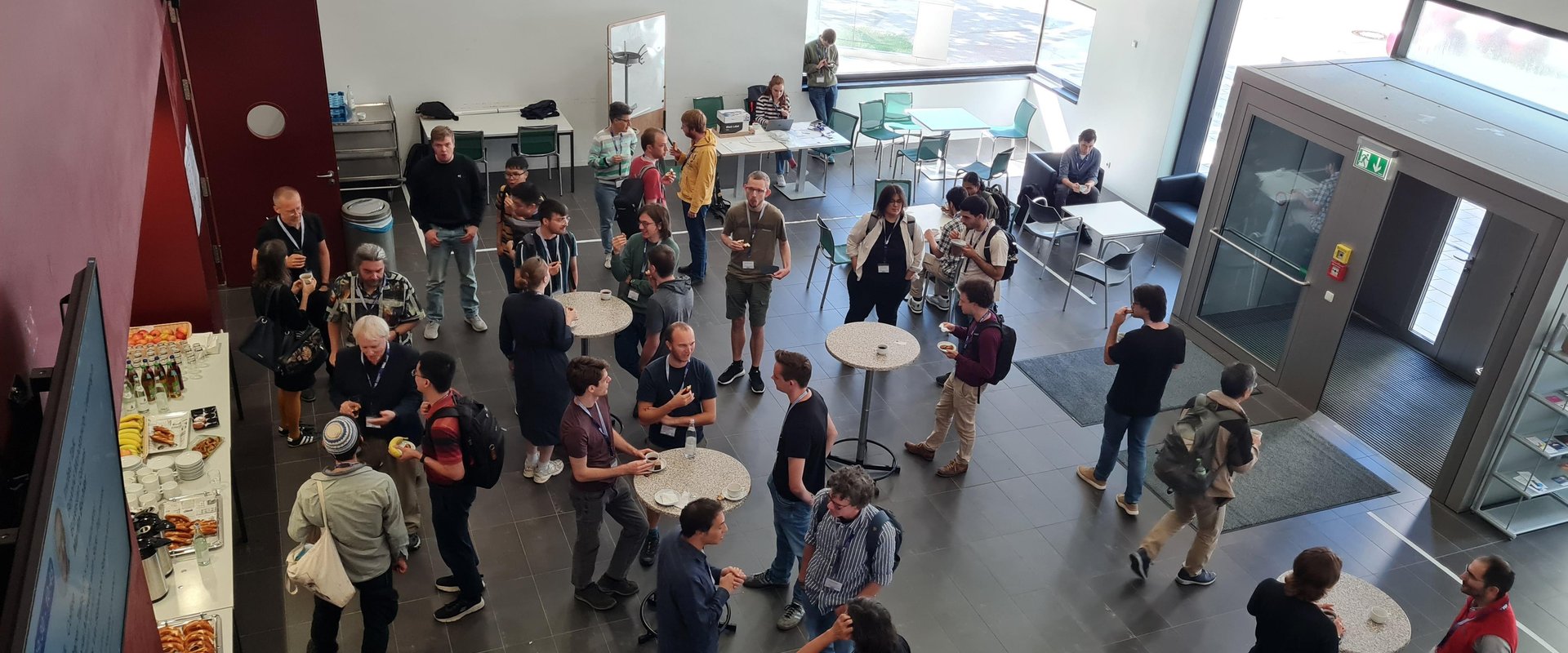
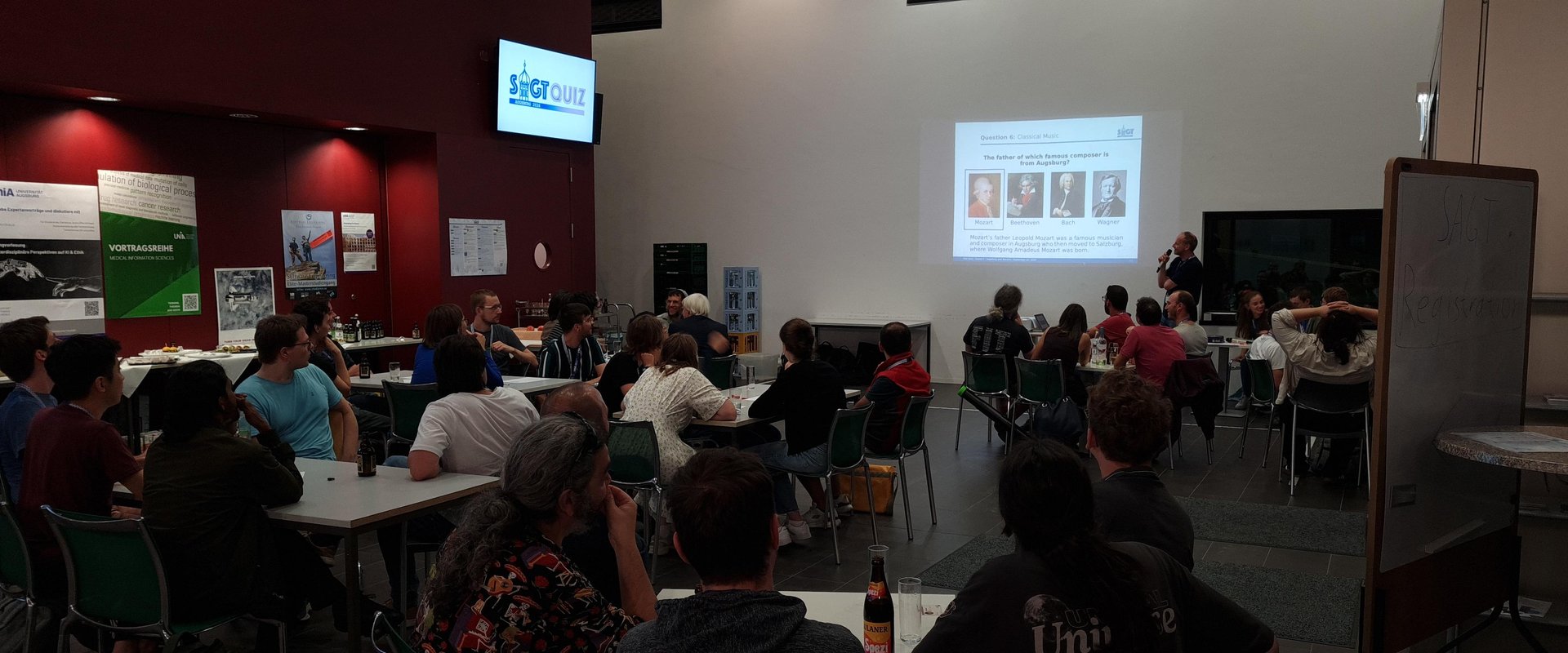
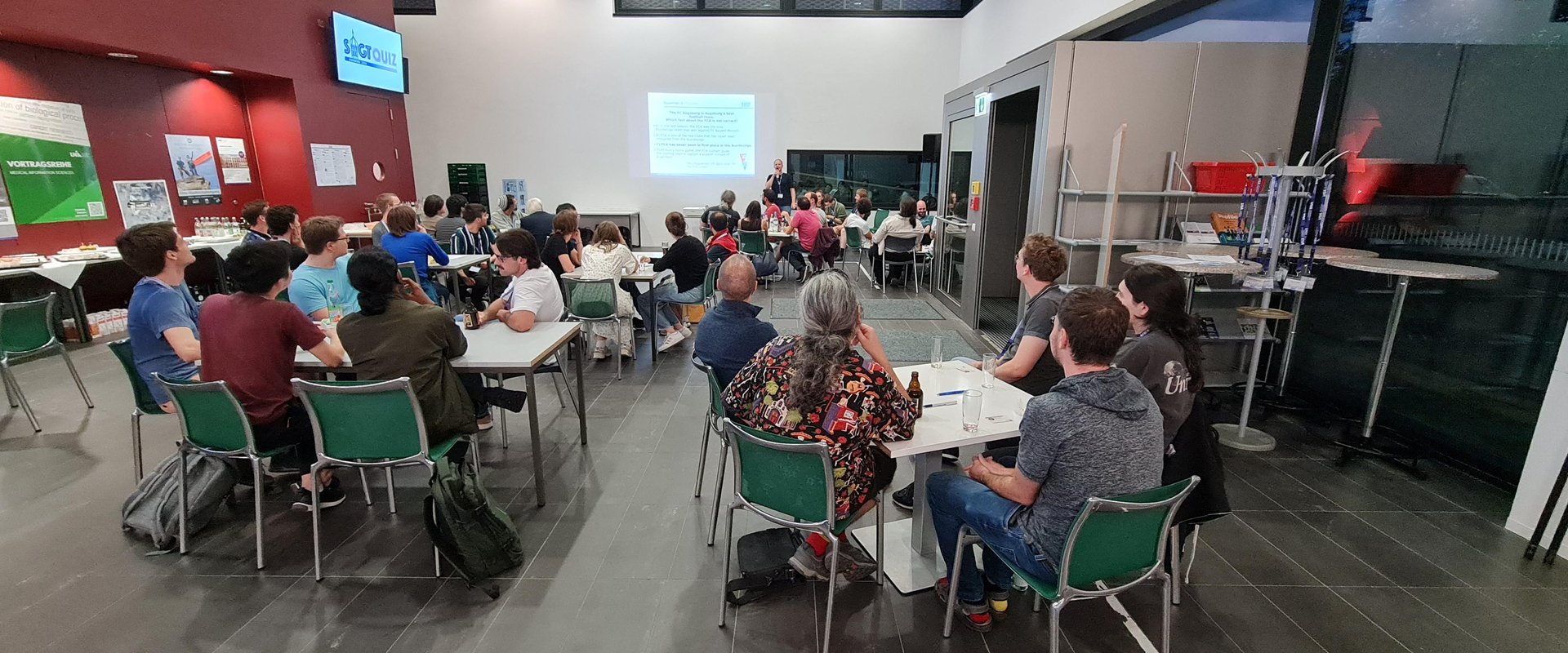
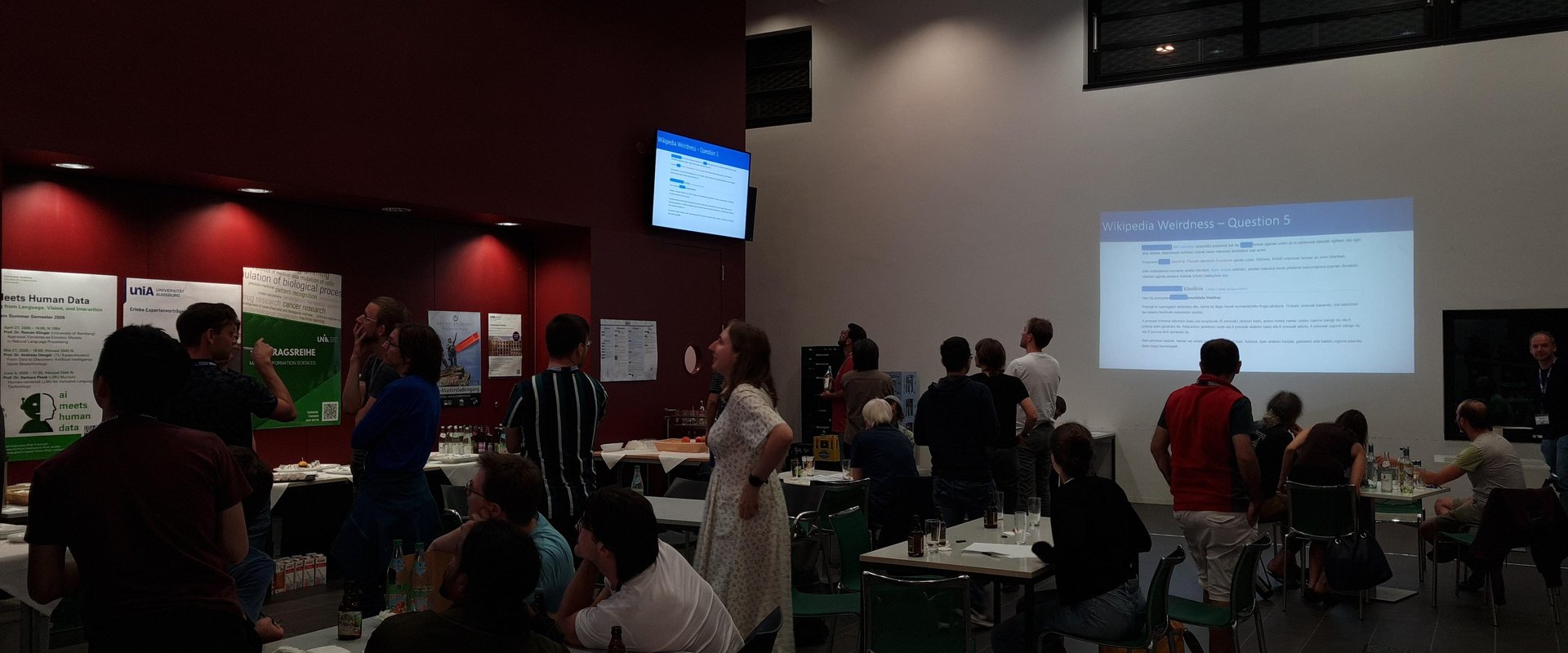
Gallery
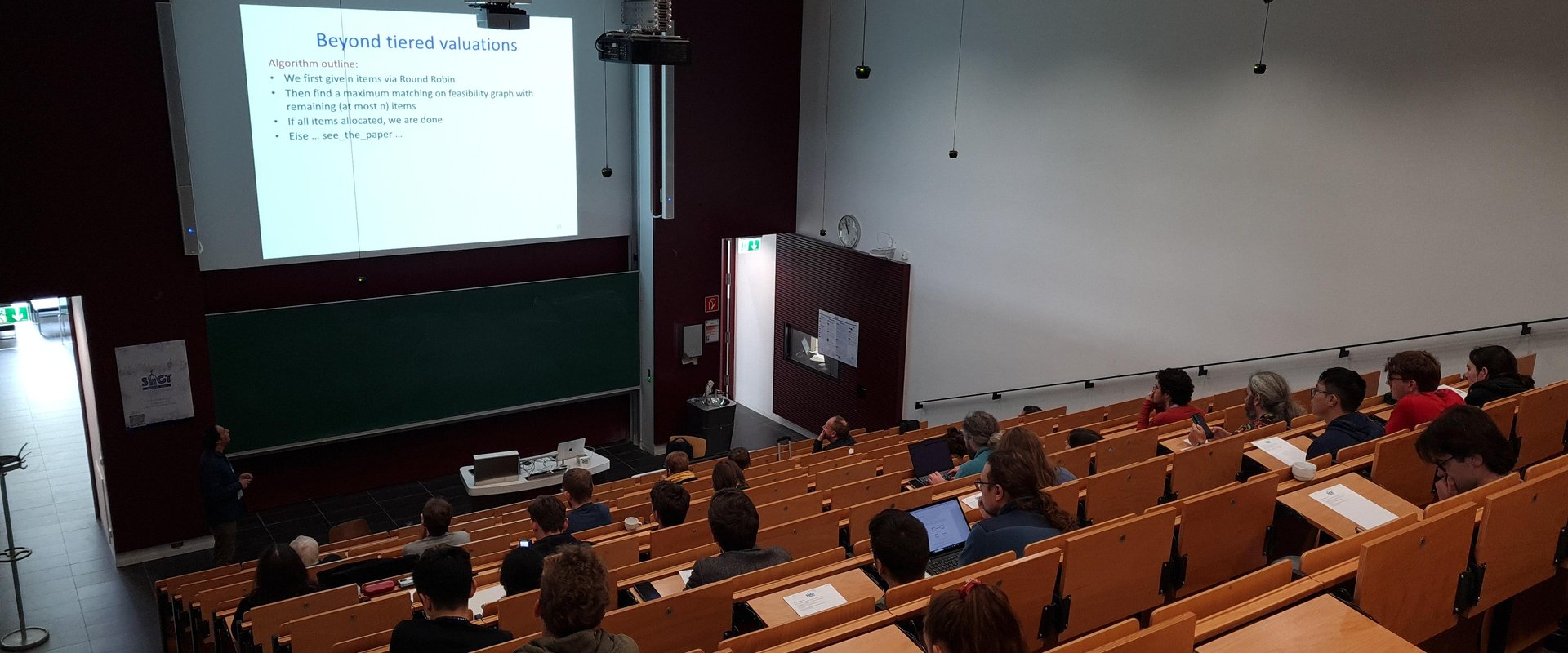
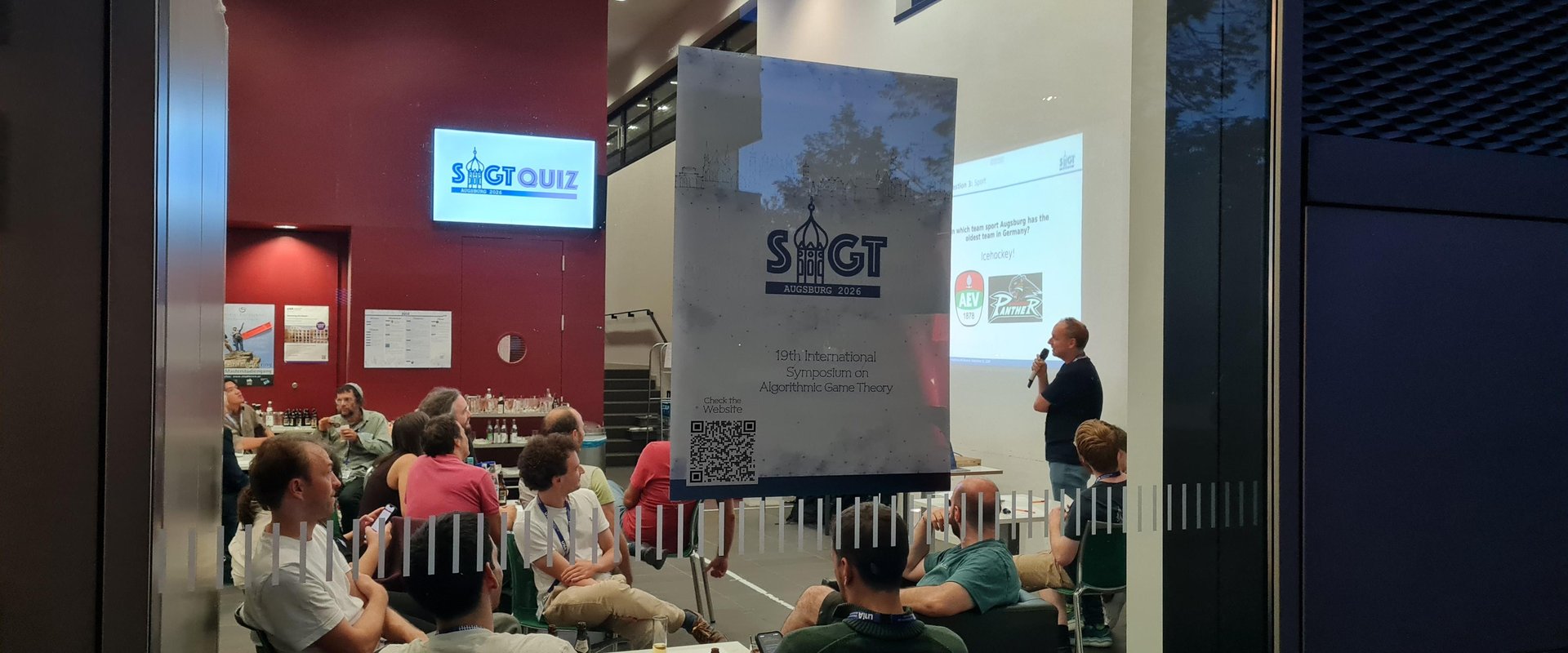
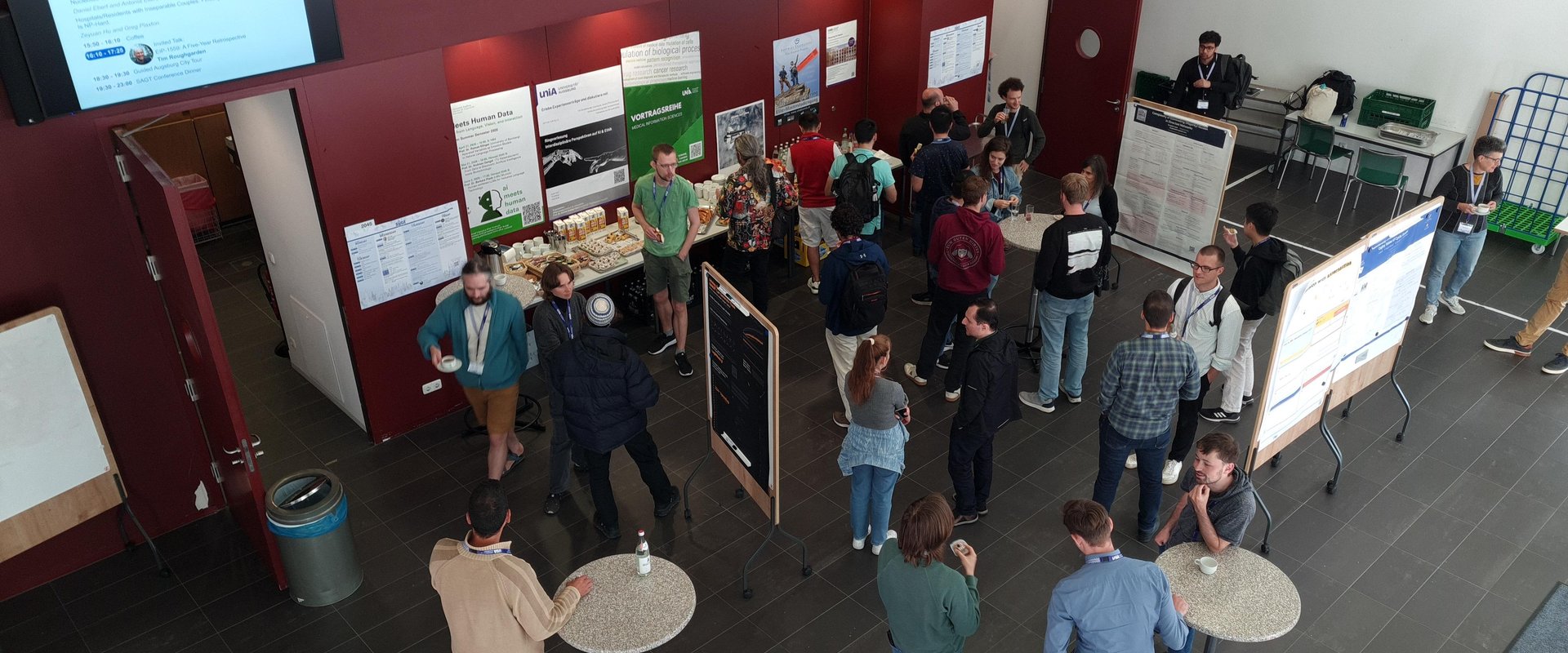
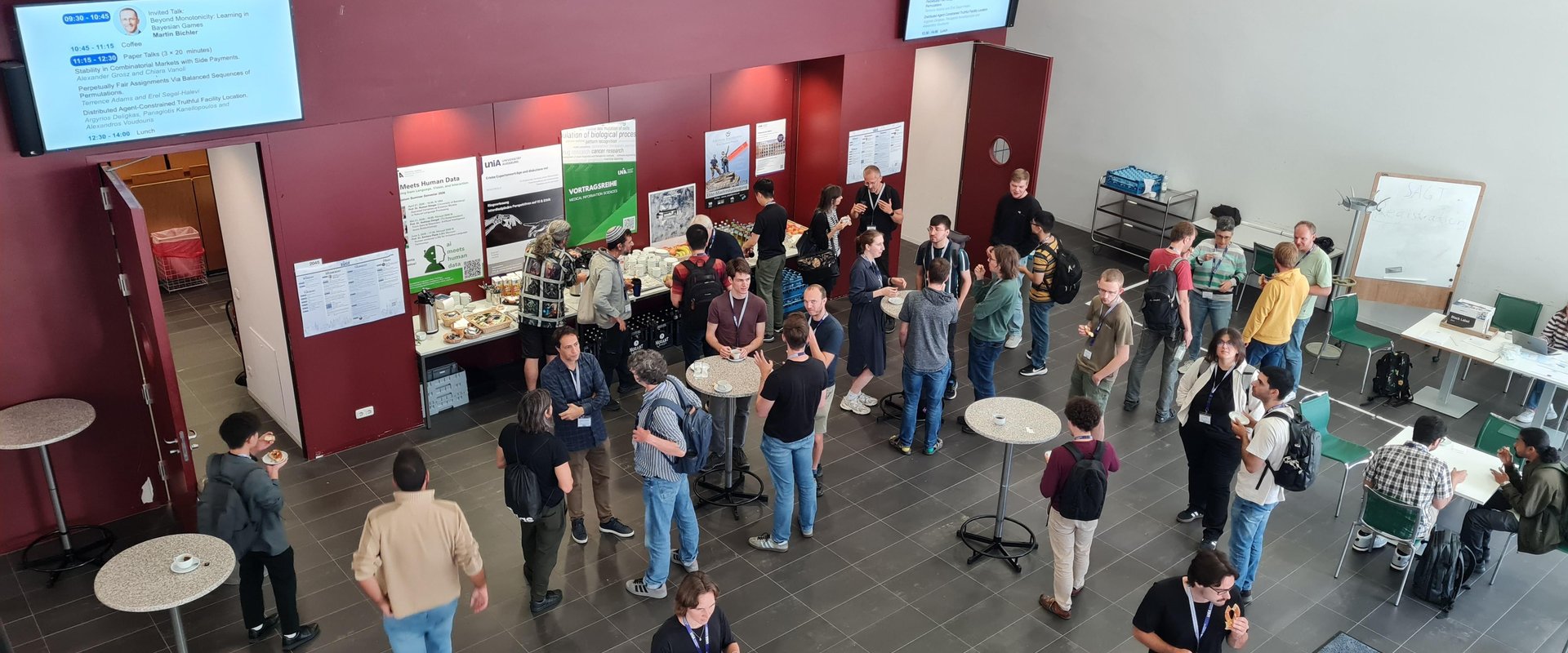
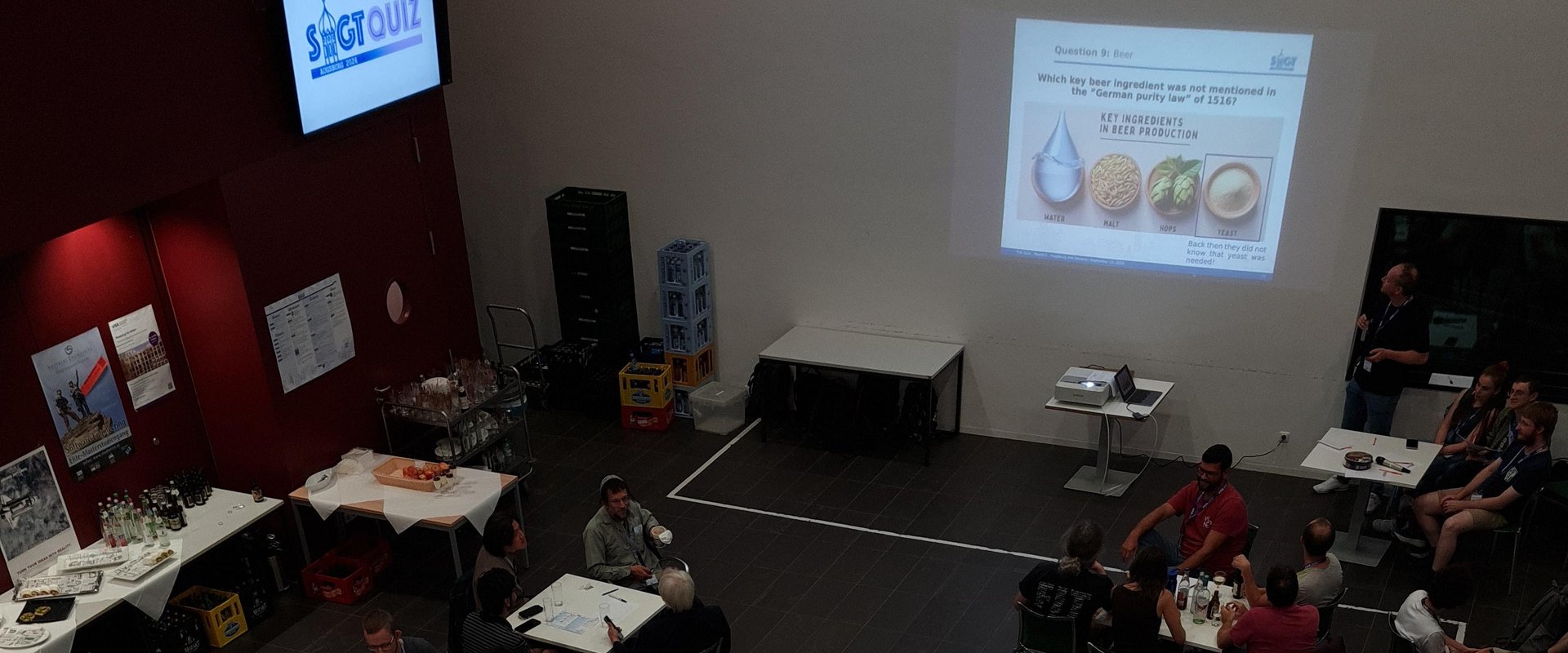

SAGT Invited Speakers


Invited Talks:
In standard congestion games, players aim to minimize their absolute cost. In this talk, we consider a natural variant arising in competitive environments, where the goal is to perform well relative to competitors. Specifically, players have lexicographic preferences: their primary objective is to minimize their rank within the cost vector, with the minimization of their actual cost serving as a secondary goal. We analyze how this ordinal twist disrupts standard game properties. We explore its impact on equilibrium existence, computational complexity, the convergence of best-response dynamics, and equilibrium inefficiency. Our analysis covers several specific, well-explored congestion and cost-sharing games, such as job scheduling and network routing. As we show, the rank-based objective significantly influences the strategic landscape of the game, transforming some environments with guaranteed stability and exact potential functions into settings where convergence is fragile, and equilibria are computationally hard to find or highly inefficient.

Pre-SAGT Workshop on Mechanisms with Predictions
Lecturers:


The workshop will consist of interactive lectures and exercises given by Vasilis Gkatzelis and Guido Schäfer. The goal is to gently introduce the exiting new field of mechanisms with predictions to young researchers. Thus, the workshop is intended for studends and early-career researchers. Of course, more senior researchers are very welcome as well!
The Pre-SAGT workshop can be combined with SAGT conference attendance or it can be booked as a stand alone event. Feel free to join!
Timeline:
Start: 14 September 2026 at noon
End: 15 September 2026 late afternoon

Accepted Papers
• Perpetually Fair Assignments Via Balanced Sequences of Permutations. Terrence Adams and Erel Segal-Halevi
• Extension of Excess Demand Ascending Auction to Multi-Demand Model by Discrete Convex Analysis Approach. Kazuo Murota and Akiyoshi Shioura
• Minimizing Cumulative Envy in Allocating a Sequence of Items. Paul Goldberg, Isaac Robinson and Nicholas Teh
• Computing Fair and Efficient Indivisible Chore Allocations with Bounded Surplus. Nicholas Teh
• Temporal Fair Division of Indivisible Goods with Structured Constraints. Kui-Wang Choi and Minming Li
• Stability in Combinatorial Markets with Side Payments. Alexander Grosz and Chiara Vanoli
• Efficiently Restructuring Sovereign Debt via Arctic Auctions with Convex Costs. Jugal Garg, Edwin Lock and Vijay Vazirani
• Distributed Agent-Constrained Truthful Facility Location. Argyrios Deligkas, Panagiotis Kanellopoulos and Alexandros Voudouris
• Simultaneous Ordinal Maximin Share and Envy-Based Guarantees. Timo Reichert and Hannaneh Akrami
• Control and Bribery in Stable Marriage and Roommates: A Complete Complexity Landscape. Jiehua Chen and Ildikó Schlotter
• Fair Division with Binary Valuations: Characterizations. Florian Brandl, Warut Suksompong and Nicholas Teh
• On the Power of Deception in Repeated Games. Melissa Dutz, Dimitar Chakarov, Saba Ahmadi and Avrim Blum
• Robustness of Persuasion to Receiver Preferences. Ronen Gradwohl, Fengming Hu and Rann Smorodinsky
• Network Allocation Games with Anonymous Preferences. Argyrios Deligkas, Eduard Eiben, Šimon Schierreich and Alexandros Voudouris
• Improved Lower Bounds and Output Augmentation for Facility Location Mechanisms. Rafael Gomes, Sophie Klumper, Guido Schäfer and Jens Schlöter
• Single-Agent Stability in Additively Separable Hedonic Games with Constrained Coalition Sizes. Martin Bullinger, Adam Dunajski, Edith Elkind and Matan Gilboa
• Distributionally Robust Contract Design with Deferred Inspection. Halil Ibrahim Bayrak and Martin Bichler
• Bribery’s Influence on Ranked Aggregation. Pallavi Jain and Anshul Thakur
• Improved Approximation Guarantees for Groupwise Maximin Share Fairness. Georgios Amanatidis, Anna Korfiati, Evangelos Markakis and Christodoulos Santorinaios
• Individual Rationality in Constrained Hedonic Games: Friends, Enemies, and Neutrals. Šimon Schierreich and Ildikó Schlotter
• Leveraging Matchings in Constrained Fair Division with a Conflict Graph. Evangelos Markakis and Michalis Samaris
• Realist Vampire(s) Seeking Consenting Suicidal Person(s). Fabien Mathieu
• Nucleolus Computation by Non-Zero-Constrained Optimization. Daniel Ebert and Antonia Ellerbrock
• Hospitals/Residents with Inseparable Couples: Finding a Coalition-Stable Assignment Is NP-Hard. Zeyuan Hu and Greg Plaxton
• Complexity of Eliminating (Majority) Illusion in Directed Networks. Sougata Jana and Sanjukta Roy

Program Committee
Elliot Anshelevich, Rensselaer Polytechnic Institute, USA
Vittorio Bilò, University of Salento, Italy
Davide Bilò, University of L'Aquila, Italy
Georgios Birmpas, University of Liverpool, UK
Martin Bullinger, University of Bristol, UK
Javier Cembrano, Universidad de Chile, Chile
Ágnes Cseh, University of Bayreuth, Germany
Bart de Keijzer, King's College London, UK
Argyrios Deligkas, Royal Holloway University of London, UK
Angelo Fanelli, CNRS, France
Yiding Feng, Hong Kong University of Science and Technology, Hong Kong
Diodato Ferraioli, University of Salento, Italy
Aris Filos-Ratsikas, University of Edinburgh, UK
Dimitris Fotakis, National Technical University of Athens, Greece
Paul Goldberg, University of Oxford, UK
Lukas Graf, University of Passau, Germany
Svenja Griesbach, RWTH Aachen, Germany
Sushmita Gupta, The Institute of Mathematical Sciences, India
Guillaume Haeringer, Baruch College, USA
Kristoffer Arnsfelt Hansen, Aarhus University, Denmark
Martin Hoefer, RWTH Aachen, Germany
Anthony Kim, Sungkyunkwan University, Korea
Pieter Kleer, Tilburg University, Netherlands
Max Klimm, Technische Universität Berlin, Germany
Dušan Knop, Czech Technical University in Prague, Czechia
Piotr Krysta, Augusta University, USA
Pascal Lenzner, University of Augsburg, Germany (co-chair)
Bo Li, The Hong Kong Polytechnic University, Hong Kong
Minming Li, City University of Hong Kong, Hong Kong
Tao Lin, The Chinese University of Hong Kong, Hong Kong
David Manlove, University of Glasgow, UK
Vangelis Markakis, Athens University of Economics and Business, Greece
Francisco Javier Marmolejo Cossio, Harvard University, USA
Claudio Mezzetti, The University of Queensland, Australia
Tim Oosterwijk, Vrije Universiteit Amsterdam, Netherlands
Sigal Oren, Ben-Gurion University, Israel
Maria Polukarov, King's College London, UK
Baharak Rastegari, University of Southampton, UK
Doron Ravid, University of Michigan, USA
Rebecca Reiffenhäuser, University of Amsterdam, Netherlands
Shaul Rosner, Tel Aviv University, Israel
Jörg Rothe, Heinrich Heine University Düsseldorf, Germany
Guido Schäfer, CWI Amsterdam, Netherlands
Šimon Schierreich, AGH University of Krakow, Poland
Daniel Schmand, University of Bremen, Germany (co-chair)
Ulrike Schmidt-Kraepelin, TU Eindhoven, Netherlands
Daniel Schoepflin, Rutgers University, USA
Marc Schröder, Maastricht University, Netherlands
Golnoosh Shahkarami, University of Bremen, Germany
Alexander Skopalik, University of Twente, Netherlands
Maximilian Stahlberg, University of Bremen, Germany
Yixin Tao, Shanghai University of Finance and Economics, China
Artem Tsikiridis, TU Munich, Germany
Marc Uetz, University of Twente, Netherlands
Giovanna Varricchio, Università della Calabria, Italy
Carmine Ventre, King's College London, UK
Adrian Vetta, McGill University, Canada
Anaëlle Wilczynski, Université Paris-Saclay, France
Jie Zhang, University of Bath, UK
Hanrui Zhang, Chinese University of Hong Kong, Hong Kong

Hotels & Transportation
Hotels in Augsburg
Augsburg has many hotels. However, for your convenience, we advise you to avoid taking a hotel in the north of Augsburg, as the travel time could be too high.
From the city center (Königsplatz), you can travel to the university within 15 - 20 minutes, using public transport. Thus, we recommend choosing a hotel located somewhere between Königsplatz and the university, or a hotel that is moderately close to a stop of the tram line 3.
Transportation

If you plan to travel via regional trains (e.g. from Munich airport to Augsburg), we recommend the Deutschlandticket. It costs 63 euros per month and offers unlimited travel on local and regional public transport (buses, trams, S-Bahn, U-Bahn, and regional trains) across Germany.
We recommend buying it via the official DB Navigator app or website, or through Mopla.
Please Note: IC, EC, ICE trains are not included. The ticket is a monthly subscription, so it must be purchased in advance and canceled by the 10th of the month, otherwise it renews automatically. Thus, we recommend buying it before 10 Sep 2026 and then to directly cancel the contract to avoid renewal.

Time and Location
Location
Conference: University of Augsburg, Universitätsstraße 6a, 86159 Augsburg, Germany. Computer Science Building (Building N, main campus), Lecture Hall 2045N
Arriving at Lecture Hall 2045N
Address:
Universitätsstraße 6a
86159 Augsburg
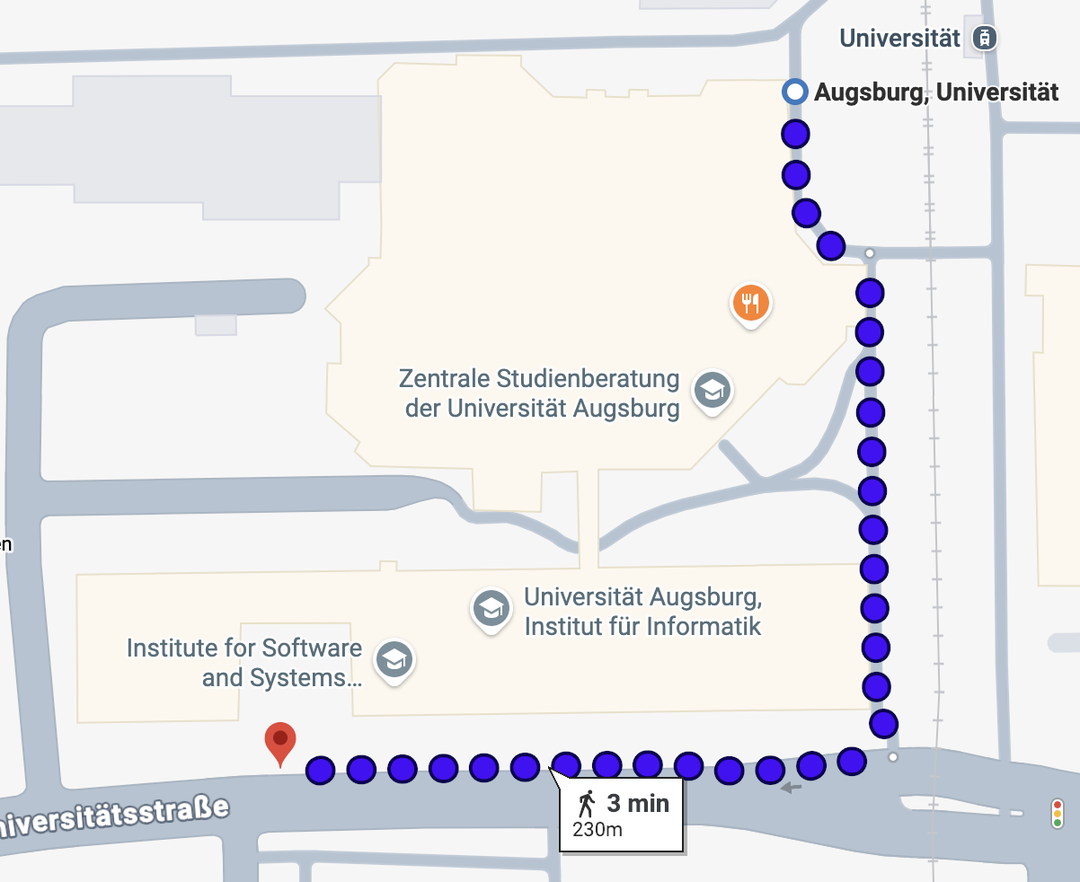
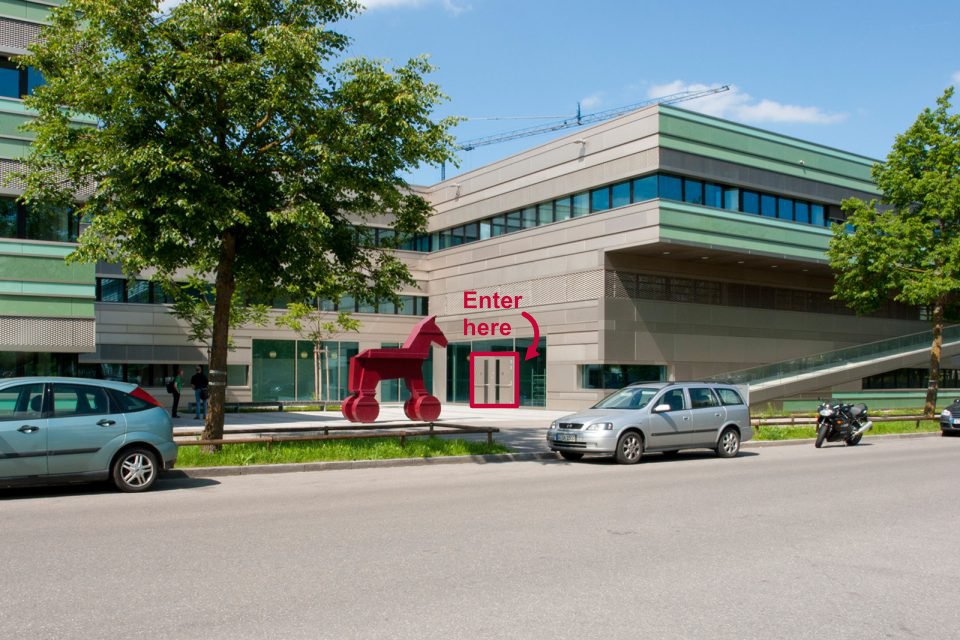
To reach the workshop room after you exit the tram at the stop "Universität", head south and follow the pedestrian path until you encounter a big crossing. At the crossing, head right and walk until you arrive at the sculpture of a red trojan horse.Look into the direction the horse is looking and enter through the door you see on the ground level. If you enter through this door, the lecture hall 2045N, is directly in front of you.

Travel Recommendations
Beyond Augsburg, visitors can easily explore some nearby cities such as Munich with its historic landmarks and beer gardens, Ulm with its scenic Danube views and record-breaking church steeple, and Nuremberg with its medieval Old Town and rich history. The highlights of the area are the following:
Fuggerei

Fuggerei is the world’s oldest social housing complex still in use, founded in 1521 by the Fugger family. This historic neighborhood is known for its charming narrow streets, colorful houses, and peaceful atmosphere in Augsburg. Visitors can explore museum apartments, learn about over 500 years of social history, and experience one of the city’s most unique cultural landmarks.
Oktoberfest & Plärrer

Held annually in Munich, Oktoberfest is the world’s largest beer festival and one of Bavaria’s most celebrated traditions. In 2026, Oktoberfest will take place from September 19 to October 4, welcoming millions of visitors to experience lively beer tents, traditional Bavarian music, local cuisine, and cultural events. If you want a smaller version, you can also visit the "Plärrer" in Augsburg, which runs until 11pm on September 13.
Neuschwanstein Castle

Often referred to as the “Disney Castle,” Neuschwanstein Castle is one of Germany’s most iconic landmarks and the inspiration behind the famous Disney castle design. Nestled in the Bavarian Alps, the fairy-tale palace was commissioned by King Ludwig II of Bavaria and captivates visitors with its dramatic towers and breathtaking mountain scenery.
Important Dates
Full paper submission: 26 May 2026, AoE
Notification: 09 July 2026
Camera Ready Submission: 24 July 2026, AoE
Submission instructions
Authors are invited to submit original research for possible presentation at the conference. Each paper will be evaluated on significance, originality, technical quality, and exposition. It should clearly establish the research contribution, its relevance, and its relation to prior research.
Where to Submit
SAGT 2026 uses Easychair.
Submission is closed.
Submissions may be up to 18 pages long (including title page and references) in LNCS format. Note that SAGT 2026 requires submissions in LNCS format (provided as part of Springer's LaTeX2e package). In addition, an appendix may be included at the end of the paper and will be read at the discretion of the reviewers. Submissions deviating from these guidelines may be rejected without review.
Authors are strongly encouraged to structure their paper in a way that includes a clear presentation of the merits of the paper and a discussion of the importance of the results, as well as an exposition of the key conceptual and technical ideas.
A conflict of interest (COI) is limited to the following categories:
• Family member or close friend
• Ph.D. advisor or advisee (no time limit), or postdoctoral or undergraduate mentor or mentee within the past five years
• Person with the same affiliation
• Involved in an alleged incident of harassment (it is not required that the incident be reported)
• Reviewer owes the author a favor (e.g., recently requested a reference letter)
• Frequent or recent collaborator, i.e., current joint work in progress or joint publication within the last 5 years, whom you believe cannot objectively review your work
To accommodate the publishing traditions of different fields, authors of accepted papers can choose to publish a one-page abstract of their paper in the proceedings. The paper must then provide a URL referring to the full version of the paper; authors should guarantee the link to be reliable for at least two years. Such papers must be formatted and submitted just like regular papers (as described above).
Results previously published or presented at another archival conference prior to SAGT, or published (or accepted for publication) at a journal prior to the submission deadline, will not be considered for publication. Simultaneous submission to WINE 2026 is explicitly allowed. In case the paper is accepted for publication at SAGT, the authors have to withdraw the paper from WINE 2026. Simultaneous submission to other conferences with published proceedings is not allowed. Simultaneous submission of results to a journal is allowed only if the authors publish the paper as a one-page abstract in SAGT 2026.
SAGT 2026 will extend invitations to a selection of accepted papers for publication in a dedicated special issue of the ACM Transactions on Economics and Computation (TEAC) (details will be communicated in due course).
The SAGT proceedings of previous years are available on SpringerLink
Due to generous funding from Springer LNCS we will offer a Best Paper Award.
Also, as a novelty, we will honor the best conference presentation with a Best Presentation Award.
History of SAGT
• SAGT 2021, Aarhus
• SAGT 2014, Patras
• SAGT 2013, Aachen
• SAGT 2012, Barcelona
• SAGT 2011, Salerno
Organization
General Chairs:
• Pascal Lenzner, University of Augsburg
Local Organizers:
Sponsors