
German-Turkish Dual Master’s Degree: Qualification for Two Legal Systems
DAAD Supports the Development of a New Master’s Program in Law at the University of Augsburg
A German-Turkish dual master’s program in law is planned at the University of Augsburg. The university is developing it in collaboration with Istanbul Kültür Üniversitesi. This master’s program, the only one of its kind in Germany, is being funded by the German Academic Exchange Service (DAAD) during its development phase and is expected to begin in the 2027–2028 winter semester, preparing students for careers in Germany, Turkey, and the international legal arena. The Faculty of Law at the University of Augsburg is further expanding its international focus: Together with Istanbul Kültür University (İKÜ), it is developing a German-Turkish double-degree master’s program with the working title “German-Turkish Law.” The program will equip lawyers with the skills to navigate confidently between the two legal systems and cultural spheres. Unlike existing German-Turkish programs in business law, the Augsburg program takes a comprehensive approach. Students gain knowledge of German and Turkish law and can choose individual areas of specialization, such as business law, criminal law, tax law, constitutional law, or civil law. The curriculum is supplemented by future-oriented topics such as digitalization, artificial intelligence, and environmental law. The DAAD is supporting the development of the degree program as early as the preparatory phase. In the future, funding of up to 800,000 euros may be secured for mobility and project development. Funding will support, among other things, student mobility during their study period in the partner country, as well as travel by project participants for the development and implementation of the program. An application for continued funding has been submitted for the initial phase of the degree program. PD Dr. Stefan Lorenzmeier, LL.M., from the Faculty of Law at the University of Augsburg is coordinating the development of the new master’s program. He emphasizes the strategic importance of the project: “The joint German-Turkish degree program is an excellent fit for our students’ interests and for the international orientation of the university and the faculty. It builds on the existing Turkish law curriculum in Augsburg and is intended to help further deepen relations between Germany and Turkey. The funding from the DAAD enables us to act as bridge-builders.” Istanbul Kültür Üniversitesi is a state-recognized Turkish foundation university with a special focus on Germany and German law. It maintains twelve Erasmus partnerships with German universities and offers courses on German law in both German and Turkish.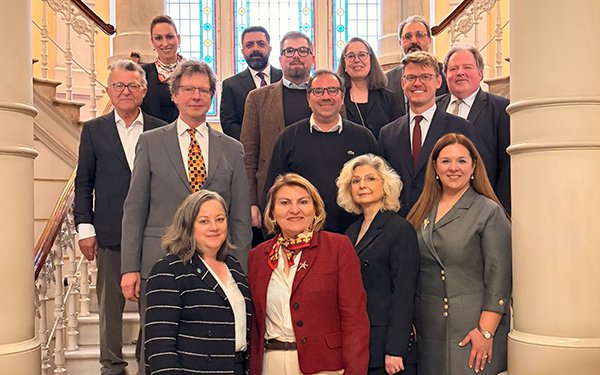
The two-year program is expected to begin in the winter semester of 2027/2028. Students will spend one year at each university. Classes will be taught in the respective national language. Students spend one year at each university. Classes are taught in the respective national language. The first cohort is expected to include about ten students.A Unique Program with a Broad Legal Focus
Graduates will be well-prepared for careers in companies, law firms, associations, or academic institutions in Germany and Turkey. At the same time, they will acquire the skills needed to address cross-border legal issues in an increasingly interconnected European and international environment.DAAD Funding Supports Program Development
A Bridge Between Two Legal Systems
The partner university in Istanbul also views the project as an important contribution to international legal education. Dr. Hilal A. Öztürk, Germany Representative at İstanbul Kültür Üniversitesi, says: “With this joint double-degree master’s program, İstanbul Kültür Üniversitesi and the University of Augsburg are sending a strong signal in support of German-Turkish university cooperation. Our goal is to train lawyers who are well-versed in both legal systems and can competently resolve cross-border issues.”Partner University with Close Ties to Germany
Scientific contact
Media contact