
Synthetic cells: new functions through mutation
Paper with Augsburg involvement published in Nature Chemical Engineering
Just a few genetic mutations transform simple RNA droplets into cell-like structures with surprising capabilities: they form cavities, move and store molecules. Researchers have now succeeded in unravelling the underlying mechanisms. The findings have been published in Nature Chemical Engineering. How life could have arisen from non-living matter is one of the oldest unsolved questions in science. For this to happen, a minimal cell must at least preserve its genetic material whilst also being capable of changing. To achieve the goal of creating such a minimal living cell, researchers are working with RNA droplets. These are liquid-like, membrane-less nanostructures made of artificially produced ribonucleic acids (RNA) that spontaneously aggregate. These RNA droplets can enclose within them the genetic template from which they are transcribed. “This fulfils a basic prerequisite for a system that can evolve,” says William Verstraeten, a PhD student in the research group in Heidelberg. To the researchers’ surprise, targeted modifications to the DNA template did not, as expected, lead to the dissolution of the droplets. “Instead, they formed large cavities, known as vacuoles, which remained stable for days and weeks,” says Göpfrich. These are complex changes in such primitive synthetic cells. Prof. Dr Michael Platten’s team at the German Cancer Research Centre was able to identify which mutations were responsible for the structural changes inside the droplets using a specialised sequencing technology. This made it possible to create a ‘model mutant’ and reproduce the effect at will. “The vacuoles form when, during transcription, more and more RNA enters the already viscous interior of the droplets. The rapid accumulation of mass can lead to local instabilities, from which the cavities form,” explains Prof. Dr Christoph Weber from the Institute of Physics at the University of Augsburg. The RNA droplets must have a radius of more than 20 micrometres and contain more than around two per cent genetically modified material for vacuoles to form, as the scientists were able to confirm in experiments. Further investigations have shown that the cavities lead to a redistribution of mass within the droplets, thereby generating minute movements on the micrometre scale. According to the scientists, mutated RNA droplets moved considerably further than unmutated ones and collided with one another more frequently; as a result, they fused and grew. In this process, the vacuoles act as internal storage compartments: “They take up small molecules and can store this cargo inside them,” explains Göpfrich. The research was carried out as part of the DFG-funded Collaborative Research Centre / Transregio 392 ‘Molecular Evolution in Prebiotic Environments’. The research groups led by Kerstin Göpfrich in Heidelberg and Christoph Weber in Augsburg are involved in this project. The European Research Council, the International Human Frontier Science Programme Organisation, the Alfried Krupp von Bohlen und Halbach Foundation and the Carl Zeiss Foundation have funded the research. The findings have been published in the journal Nature Chemical Engineering. W. Verstraeten, M. P. Tran, A. Taskina, P. Jaiswal, I. S. Haugerud, C. Helbig, M. Hamberger, E. W. Green, M. Platten, C. A. Weber, and K. Göpfrich: Genetic encoding and mutagenesis of RNA droplet phenotypes. Nature Chemical Engineering (7 October 2026), https://doi.org/10.1038/s44286-026-00454-4
A small number of random genetic mutations cause simple RNA droplets to transform into cell-like structures. In this process, they form cavities, can move and are able to take up cargo. This has been demonstrated through research using nanostructures based on ribonucleic acid led by Prof. Dr. Kerstin Göpfrich at the Center for Molecular Biology of Heidelberg University (ZMBH) in cooperation with experts from the German Cancer Research Center and the University of Augsburg. Just a few molecular changes are enough to trigger these complex processes in very simple synthetic cells – a principle that the researchers also hope to harness for medical applications.How does life emerge?
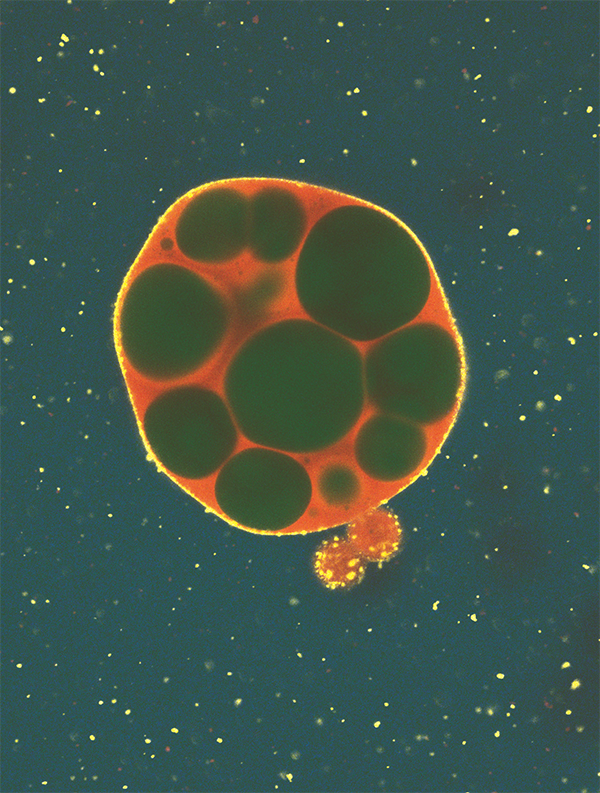
So entstehen die Hohlräume
Mutated RNA: highly mobile and with storage space
“Mutagenesis thus provides us with a new architecture and new functions which, if we were to recreate them from scratch, we would find extremely difficult to design,” emphasises the Heidelberg-based molecular biologist. In future, this tool is to be used to develop synthetic immune effectors capable of generating specific immune functions themselves.DFG Collaborative Research Centre
Original publication:
Additional information can be found on the
website dedicated to the research projects.
Media contact