
Publication Award from the Bavarian Centre for Cancer Research for the Augsburg Department of Pathology
How can rare tumours – which could be relevant for targeted cancer therapy but may go undetected by conventional tests – be identified? An award-winning scientific paper from Augsburg University Medical Centre addresses this question. For their publication in the journal npj Precision Oncology, researchers from the Institute of Pathology and Molecular Diagnostics at Augsburg University Hospital have been awarded this year’s Publication Award by the Bavarian Centre for Cancer Research (BZKF). The study focuses on specific forms of colon and rectal cancer involving changes in the POLE gene. Such mutations can lead to a particularly high accumulation of changes in the genetic material of the tumour cells. As a result, the tumours may be particularly easily recognised by the immune system and respond exceptionally well to immunotherapy, even at advanced stages. These drugs help the immune system to fight cancer cells more effectively. “We were interested in finding out whether we could use the molecular data – which is collected as part of routine diagnostics anyway – to identify this rare group of tumours. This is because, particularly with such tumours, recognising their specific genetic characteristics can be crucial,” says PD Dr Nic Reitsam, lead author of the study. A distinctive feature of these tumours is that, despite their numerous genetic alterations, they can be classified as microsatellite-stable (MSS). In colorectal cancer, microsatellite status is an important molecular marker that is taken into account, amongst other things, when assessing potential immunotherapies. The rare tumours characterised by POLE mutations may therefore be overlooked by standard classification based solely on this marker. The research team examined 675 cases of colorectal cancer for which results from a molecular genetic test were already available. An unusually high number of genetic alterations was observed in 15 of these cases. Further analysis confirmed disease-relevant POLE mutations in five of these cases. Further investigations and data from external cohorts, including in collaboration with Heidelberg University Hospital, supported these findings. The study thus demonstrates how existing data from routine diagnostic procedures can be used to specifically refer notable cases for in-depth molecular investigation. This can help to identify rare tumours whose molecular characteristics may be significant for the choice of treatment. “The approach is interesting because it builds on existing diagnostic data. If this data provides indications of a rare molecular alteration, we can carry out targeted further investigations and thus potentially identify tumours that would not have been detected by considering microsatellite status alone,” explains Dr Sebastian Dintner, Head of Molecular Pathology. The results highlight how closely molecular diagnostics and treatment decisions are linked in modern cancer medicine. “The study exemplifies how routine diagnostics and research can complement one another. By systematically evaluating molecular findings, we not only gain new scientific insights, but can also identify avenues for further developing diagnostics and improving the conditions for personalised therapies,” says Prof. Dr Bruno Märkl, Director of the Institute of Pathology and Molecular Diagnostics at Augsburg University Hospital. The award also highlights the prominence of the research in precision oncology, pathology and molecular diagnostics established at the Faculty of Medicine at the University of Augsburg and at Augsburg University Hospital. The paper ‘Mutation enrichment in targeted panels flags immunotherapy-responsive POLE-driven hypermutated microsatellite-stable colorectal cancers’ was published in 2026 in the internationally renowned journal npj Precision Oncology:
https://www.nature.com/articles/s41698-026-01572-1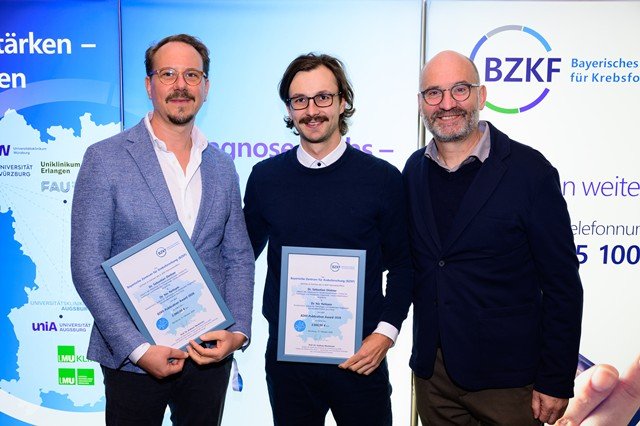
Making more targeted use of existing diagnostic data
A contribution to the further development of personalised cancer medicine