
Lecture Series: Medical Information Sciences
General information
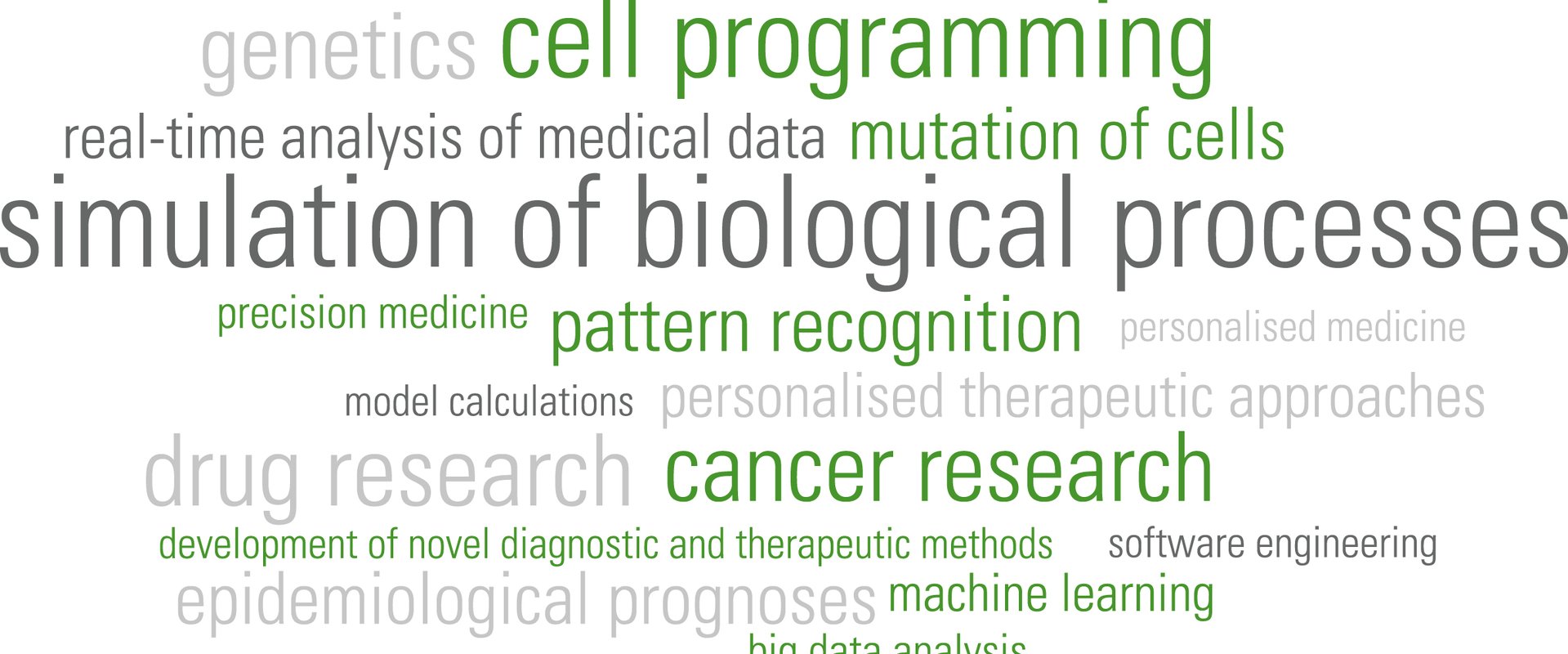
The future of medical research and healthcare is personalized, digitized, and data-driven. The provision, analysis, and interpretation of this data rely on interdisciplinary collaborations. Thus, the foundations for future medical progress are laid at the interface of medicine and computer science.
The field of research and studies Medical Information Sciences has been established as a response to this development, introducing a guest lecture series of the same name in the winter semester of 2022/2023. It adresses current questions from science and provides insights into corresponding areas of industry.
The MIS lecture series will take place this winter semester on Thursdays at 4:00 pm at the Faculty of Applied Computer Science in Lecture Hall N2045.
A shared electronic calendar for the MIS lecture series can be found at the following link: https://bioinf-nextcloud.informatik.uni-augsburg.de/apps/calendar/p/ppNc2sNPDMFBGKoG (You can access the registration link via the three dots to the left of the calendar name.)
Additionally, the events will be live-streamed. If you are interested in attending the live-stream, we kindly ask you to register by sending an informal email to office.bioinf@informatik.uni-augsburg.de on time.
The lectures aim at an interested professional audience and will be held in English.
More information about the speakers and their lectures are available on this website or via the official MIS newsletter, which you can register for at the bottom of this webpage.
In addition, prior to each lecture, we offer an opportunity to discuss individual scientific questions, topics or cooperation opportunites with the speaker. If you are interested, please register in advance by sending a short message to office.bioinf@informatik.uni-augsburg.de.
Below, you find the schedule for the winter semester 2026/27 with further information on each single lecture:
schedule for the winter semester 2026/27
Location: Lecture hall N2045 (Faculty of Applied Computer Science)
Abstract
High-throughput single-cell and multi-omics measurements provide detailed views of cellular states, yet connecting these observations to the mechanisms governing tissue dynamics remains challenging. Our work combines experimental perturbations with computational analysis and mechanistic mathematical modelling to investigate how interactions between the host and its microbiota influence intestinal epithelial homeostasis. Using Tlr2-mediated microbial sensing as a biological example, we explore how changes in epithelial signalling and metabolism relate to stem cell differentiation, crypt composition and antimicrobial function. We integrate measurements across host and microbial compartments to identify candidate processes linking microbial cues to epithelial cell states. Alongside these analyses, we have established an ordinary differential equation (ODE)-based model of intestinal epithelial cell population dynamics. This provides a framework for examining how changes in proliferation, differentiation and turnover may contribute to observed differences in tissue composition. Our ongoing work investigates how molecular signatures can inform model assumptions and parameters, and how complementary modelling approaches can help formulate experimentally testable hypotheses. The talk will present our experimental and computational strategy, selected findings and current modelling developments. It will also discuss the opportunities and challenges of translating multi-omics measurements into mechanistic explanations of tissue organisation and its response to perturbation.
Speaker: Dr. Lorenz Adlung
Biography
Dr. Lorenz Adlung leads the Adipose Systems Immunology group at the University Medical Center Hamburg-Eppendorf (UKE), where he has been an independent junior group leader since 2021. He is affiliated with the Hamburg Center for Translational Immunology (HCTI) and the Center for Biomedical AI (bAIome). He studied biology and molecular biosciences at Heidelberg University and obtained his doctorate in 2017 for research in systems biology at Heidelberg University and the German Cancer Research Center (DKFZ). He subsequently worked as a postdoctoral fellow in the laboratories of Ido Amit and Eran Elinav at the Weizmann Institute of Science in Israel. His research combines experimental immunology, single-cell and multi-omics measurements, and mechanistic mathematical modelling to study the interplay between metabolism, immunity and tissue homeostasis. His group investigates these interactions in adipose tissue, the liver and the intestine, with a particular interest in understanding inflammatory disease and cancer, and developing testable predictions from complex biological data.
Location: Lecture hall N2045 (Faculty of Applied Computer Science)
Abstract
Scientific discovery seeks mechanisms that explain observations and predict beyond the measurements that produced them. Whereas large language models (LLMs) encode knowledge implicitly, mechanistic world models organise it as a parsimonious set of explicit, modular, reusable mechanisms whose predictions can be scored against data. In biology, where measurements are sparse and noisy, mechanistic world modelling must discover latent states and governing equations jointly, yet the prior knowledge that could constrain this search is largely unstructured. We introduce gemot, an agentic framework for mechanistic world modelling, and evaluate it on 18 published biological problems spanning molecular biology, epidemiology, and immune-cell differentiation, with up to 1,755 training measurements, 65 observables, 170 experimental conditions, and 3 data modalities per problem. gemot is auditable by construction: a semantic layer records each hypothesis, and a Model Context Protocol layer separates hypothesis formulation from numerical evaluation, so hypothesis scoring cannot be fabricated. On every problem, autonomously constructed models match or exceed the reference models in fit and parsimony, and generalise where held-outs exist. We demonstratethat gemot can formulate novel, biologically plausible mechanistic hypotheses. This work will enable decoding of interventional biological data into competing mechanistic hypotheses and design experiments that distinguish between them, and may serve as a blueprint for mechanistic world modelling in other domains.
Speaker: Dr. Fabian Fröhlich
Biography
Fabian is a group leader at the Francis Crick Institute. Before joining the Crick, Fabian was a Human Frontier Science Program Fellow in the Laboratory of Systems Pharmacology at Harvard Medical School, working under the guidance of Peter Sorger. He received his PhD from Technische Universität München, working with Jan Hasenauer and Fabian Theis at the Institute of Computational Biology at Helmholtz Munich.
Location: Lecture hall N2045 (Faculty of Applied Computer Science)
Abstract
Speaker: Dr. Deepak Ravi
Biography
Location: Lecture hall N2045 (Faculty of Applied Computer Science)
Abstract
Speaker: Dr. Jan Graßhoff
Biography
Location: Lecture hall N2045 (Faculty of Applied Computer Science)
Abstract
During the intraoperative phase of a surgical procedure, continuous assessment of tissue perfusion (blood flow) is critical to surgical success. Typically, tissue perfusion is evaluated purely visually based on subtle color variations by experienced surgical staff. In open procedures, such as connecting bowel segments, an inaccurate assessment of tissue perfusion can lead to postoperative leakage with severe consequences, including abdominal infection, blood poisoning, and the need for a second surgery.
As part of the "NeoSpek" research project funded by the Carl-Zeiss-Stiftung, we investigated how continuous assessment of tissue perfusion can be achieved without interrupting the surgical workflow using multispectral and hyperspectral imaging. In particular, we explored novel methods that enable real-time contrast enhancement during surgery as well as the suppression of unwanted artifacts. Initial results show good agreement between our contrast enhancement methods and both intraoperative fluorescence imaging and the independently determined surgical resection line.
Speaker: Prof. Dr.-Ing. Stefan Kray
Biography
Stefan Kray is Professor of Medical Device Technology at Pforzheim University, where he also serves as Scientific Director of the Institute of Applied Research (IAF). He received his Diploma degree with distinction in Computer Engineering from the University of Siegen and his Dr.-Ing. (PhD) from RWTH Aachen University for his work on optical coherence tomography, for which he was awarded the Borchers Badge in 2012. Prior to his appointment in Pforzheim, he held research positions at OFFIS in Oldenburg and RWTH Aachen University, co-founded the spin-off Keratas (2nd place in the NUK Business Competition in 2013), and spent six years in the medical device industry as Project Manager for intraoral camera systems at Dentsply Sirona.
His research focuses on optical sensor systems, medical device technology, and real-time computing for clinical and industrial environments. A particular emphasis lies in multi- and hyperspectral imaging, intraoperative tissue diagnostics, and modern 3D scene reconstruction for medical applications. His work bridges applied algorithm development, optical engineering, and translational healthcare technology.
Location: Lecture hall N2045 (Faculty of Applied Computer Sciences)
Abstract
Speaker: Prof. Dr. Susanne Breitner-Busch
Biography
Location: Lecture hall N2045 (Faculty of Applied Computer Sciences)
Abstract
Speaker: PD Dr. Clemens Scherer
Biography
Location: Lecture hall N2045 (Faculty of Applied Computer Sciences)
Abstract
Speaker: Dr.-Ing. Lea C. Brandl
Biography
Lea Brandl is a medical informatics researcher with an academic background in the subject. She has Bachelor's and Master's degrees from the University of Heidelberg and the University of Applied Sciences Heilbronn. During her studies, she gained practical experience by working part-time as a software developer specialising in app and web development. For her Master's thesis, she evaluated a progressive web app designed for patients with a specific dermatological condition. She then worked at Capgemini as a developer specialising in Angular technologies. From 2020 to 2025, she conducted research at the Institute for Telematics at the University of Lübeck on 'Learning in Pervasive Games', resulting in her doctoral thesis on Ambient Serious Games. In 2026, she joined the Institute for Medical Informatics and Artificial Intelligence at Kiel University and the University Hospital Schleswig-Holstein (UKSH) as a postdoctoral researcher. She also participates in the AG Consumer Health Informatics at GMDS to continue exploring current issues in the field of medical informatics. Since September 2026, she has been the elected chair of this working group.
Location: Lecture hall N2045 (Faculty of Applied Computer Sciences)
Abstract
Speaker:
Biography
Location: Lecture hall N2045 (Faculty of Applied Computer Sciences)
Abstract
Speaker:
Biography
Miriam Nokia is a Finnish neuroscientist and professor at the Dept. of Psychology, University of Jyväskylä. Her research focuses on the neural basis of learning and memory. She is especially interested in understanding how memories are formed in the hippocampus, a key structure for episodic memory. Using electrophysiological methods and behavioral neuroscience approaches, Nokia and her team have investigated hippocampal oscillations, adult neurogenesis, sleep-related memory consolidation, and the interaction between bodily rhythms and learning.
Subscription to the MIS newsletter
We appreciate your interest in the work of the Chair of Biomedical Informatics, Data Mining and Data Analytics!
Filling in the following registration form, you can request to receive regular updates on current information as well as notifications of events related to the MIS field of research.
Registration form
By subscribing to our media, you agree to the processing of your data for the purpose of delivering the selected media, as well as to the data protection policies of the University of Augsburg. The collected data is solely used for delivering the selected media and documenting your consent. There is no other processing of the data and no sharing of the data with third parties. You may revoke your subscription and consent to the storage of your data at any time without giving any reasons. Please send a simple email to office.bioinf@informatik.uni-augsburg.de for this purpose.