
MEDoRA – Working group on medicine without racism
Hey! We are students, teachers, researchers, clinicians, interested parties, and people involved in civil society who are concerned with the topics of racism, medicine, and health.
We want to understand how racism works in medicine and how we can recognize and overcome racism.
GOALS OF THE WORKING GROUP
- Understanding the effects of racism in medicine and on health
- Developing possible courses of action
- Reflecting on one's own "racist blinders," socialization, and stereotypes
- Creating an open and safe space for discussion
- and also acting as an interface for networking among teachers, students, clinical practitioners, various departments, faculties, and civil society
BACKGROUND
"Sometimes you want to complain, but you don't want to use the word
racism [...] you still carry
the burden of having been discriminated against, but you try to put it nicely
because you are still a patient."
Interview excerpt (Ahmad) from the NaDiRa study (2023) Racism and its symptoms, p. 176
Racist discrimination makes it difficult or even impossible for people to access adequate healthcare—due to linguistic and cultural barriers as well as economic and legal ones. The medical care provided to people affected by racism is also often of poorer quality.
Racist prejudices on the part of doctors, nurses, or midwives are one of the possible causes. However, discrimination also occurs without any malicious intent on the part of those involved. The structures of the healthcare system itself contribute to people experiencing racialisation and racist discrimination and receive poorer care. There are many reasons for this: because appointments, information material, and consultation hours are not adequately translated; because medical studies and further training hardly cover specific clinical pictures in non-white people; or because discriminated groups are also severely underrepresented in medical studies.
Finally, there is also good evidence that racial discrimination itself is a psychosocial stress factor that has a negative impact on the health of those affected.
To achieve our goals, we are currently working in four subgroups to organize public events, internal and external training courses, and we are exploring opportunities for anti-racist teaching.
EVENTS
We meet once a month to exchange ideas and discuss issues, and we look forward to seeing you there.
The following dates are scheduled until the end of 2026:
- Wednesday, November 18, 2026, 3:00 p.m. – 4:30 p.m.
-
Wednesday, December 16, 2026, 12:30 p.m. – 2:00 p.m.
On Zoom and in person; the rooms will be announced shortly via email, and a Zoom link will be sent upon request.
Anyone interested in the topic of racism and health is cordially invited to attend the meetings.
Review
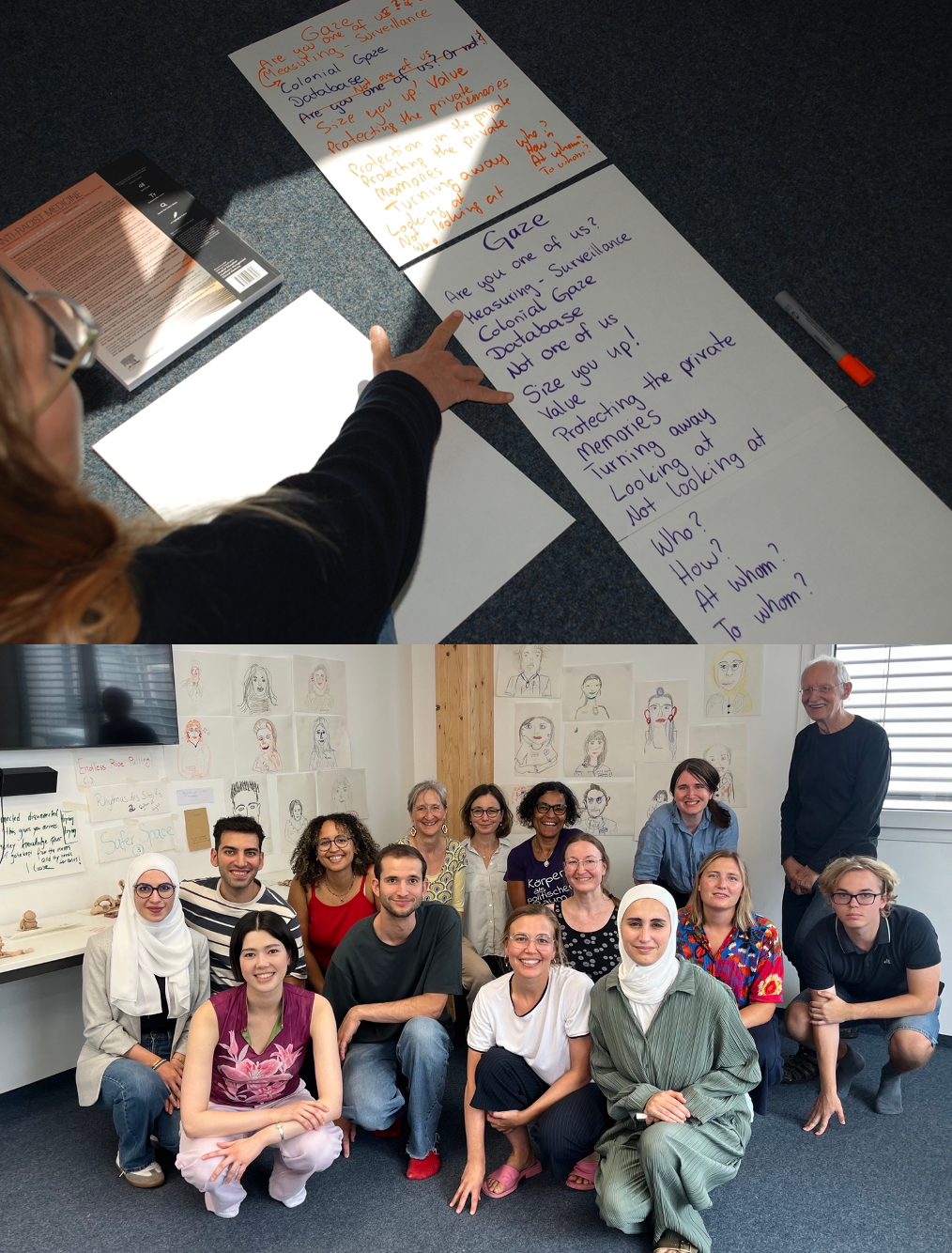
From September 14–16, 2026, the Institute for Ethics and the History of Health in Society (IEHHS) at the Augsburg Medical School hosted the workshop “Theater of the Oppressed as a Participatory Format for Addressing Racism in Medicine and Health Care.” The MEDoRA working group was also represented by several participants.
The workshop was led by Bárbara Santos, a theater director, filmmaker, author, and artistic director of the Berlin-based theater space KURINGA. She is internationally recognized as one of the most experienced experts on the “Theater of the Oppressed” and, in particular, developed the Feminist Aesthetics of “Teatro de las Oprimidas.”
Over the three days, the participants—who came from diverse academic and non-academic backgrounds and positions—reflected together on their own experiences and how to address racism in the healthcare system, using a variety of creative approaches involving the body, voice, words, sculptures, and theatrical performances. The focus was on reflecting on one’s own social and societal position, social interactions, and power structures, as well as on collective approaches to solutions.
Through the experiential, participatory methods of the “Theater of the Oppressed,” participants were able to gain a deeper understanding of the topic than purely theoretical approaches can offer.
The event ended with a forum theater session. This form of interactive theater allowed even those who had not participated in the workshop to gain insight into the results and to contribute their own solutions together with the workshop participants.
A follow-up meeting will explore ways to further leverage this approach to theater work for teaching and research.
The workshop was organized by Sylvia Agbih (IEHHS/MEDoRA) with active support on site from Nina Roob, Kathrin Jung-Can, and all participants; it was funded by the IEHHS.
As part of the Weeks Against Racism, the MEDoRA working group, in cooperation with the City of Augsburg’s Office for Social Integration, WEact e.V., and FilL e.V., organized a staged reading of the play “Family Tree.”
The author, playwright and performer Susanne Mojisola Adebayo read from her English-language staged abridged version, “Leaves from Family,” telling the story of Henrietta Lacks, a Black woman from whom cancer cells were taken for research purposes without her knowledge. To this day, the so-called HeLa cells form the basis of cancer research worldwide. This case is just one example of the scientific exploitation of people of color.
The event began with a brief introduction by the author, followed by the staged reading. Afterward, there was a discussion with an opportunity for audience participation. Moderated by Samira Eissa, Weact.
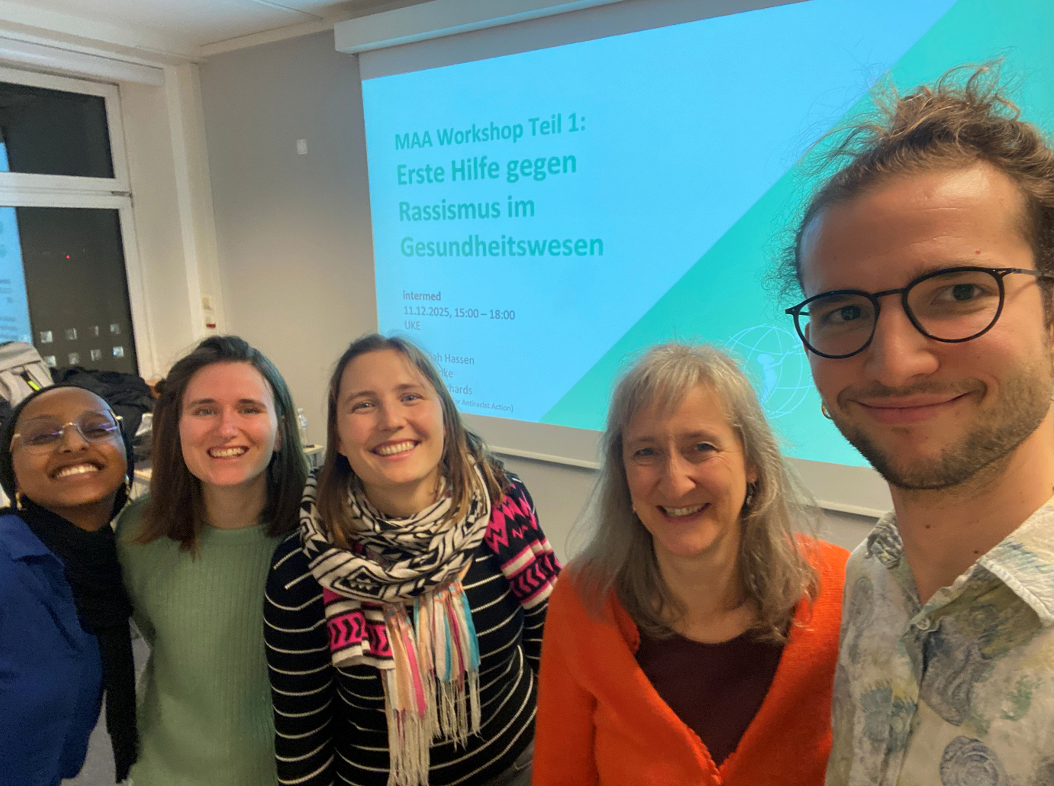
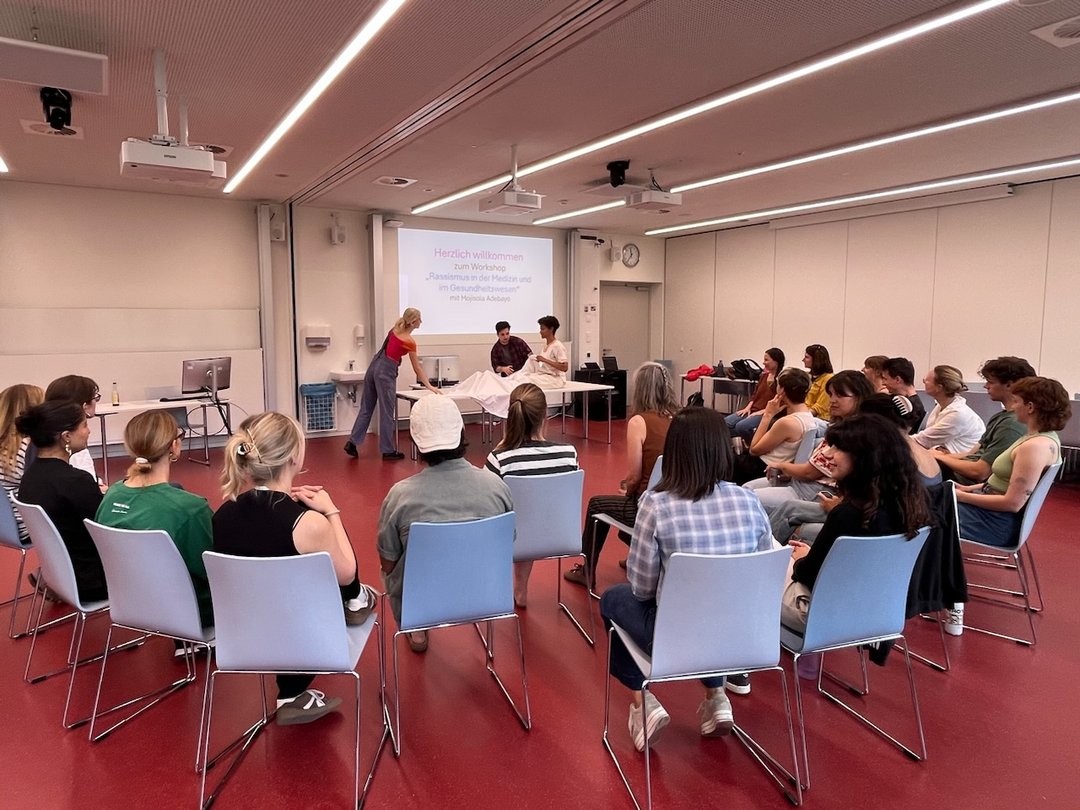
In December 2025, Nina Roob and Sylvia Agbih had the opportunity to observe a workshop on racism in medicine organized by the group MAA—Medicine for Anti-Racist Action. The two-part workshop was developed by medical students for medical students and is incorporated into the curriculum of the UKE Hamburg as a required elective course.
Part 1 used a variety of teaching methods to interactively introduce fifth-semester students to critical analysis of racism and key terminology.
Part 2 had seventh-semester students take concrete action: Using the method known as “forum theater,” they reenacted a situation from everyday medical practice in which a patient is treated in a racist manner. Afterward, the audience was able to alter the scene to explore alternative courses of action in that situation.
Both workshop formats complemented each other to form a useful toolkit for understanding and addressing racism in the healthcare system, which also serves as an inspiring foundation for the Medical Faculty in Augsburg. The MEDoRA working group remains in contact with MAA regarding a potential implementation at our location.

CONTACT
- Phone: +49 (0) 821 598-72096