
How to Play the Climate Crisis: The World Climate Game as an Interdisciplinary Learning and Research Space
The seminar brings together scientific theory, game-based simulation, and personal experience. This format exemplifies the interdisciplinary approach of the Center for Climate Resilience, which develops scientific foundations and actionable strategies for addressing the consequences of climate change.
Highlights
- Interdisciplinary collaboration between geography, economics, and political science
- A five-day intensive seminar centered around a three-day, app-based board game
- Role-based negotiations between politics, business, and civil society
- Promotion of new perspectives, cooperation, critical thinking, and reflection
- Integration of innovative teaching, research, and societal impact
Climate resilience requires different perspectives
The climate crisis is far more than just a scientific problem. Political interests, economic interdependencies, spatial inequalities, and social power structures influence which measures become feasible, who benefits from them, and who bears their costs. The research approach of the Center for Climate Resilience therefore focuses on the interactions between people, climate, and the environment and is guided by the interdisciplinary and transdisciplinary nature required for comprehensive climate resilience research.
The World Climate Game takes up this approach. It brings together students from different academic disciplines and challenges them to apply their respective expertise to a shared scenario. Differences in academic disciplines are not eliminated but rather harnessed productively: Through discussion, it becomes clear how differently the same decision can be evaluated from political, economic, and geographic perspectives.
A World Between Game Board and Simulation
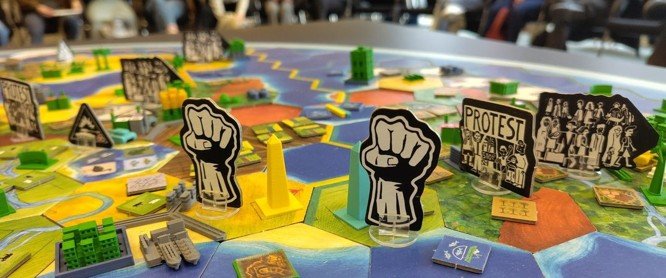
The World Climate Game is a three-day, app-based board game. It was developed by the nonprofit Weitblick GmbH in collaboration with experts in education, psychology, and climate science, and is guided, among other things, by the United Nations’ Sustainable Development Goals and findings from the reports of the Intergovernmental Panel on Climate Change.
Participants take on roles from politics, business, or civil society. Each role has its own interests, resources, and options for action. At the same time, all participants face a common challenge: within ten game rounds—which span the period from 2000 to 2100—they must create a living environment that is ecologically, economically, and socially sustainable.
Tipping points, extreme weather events, and social crises unfold depending on the group’s decisions. A hybrid climate and economic simulation reveals the consequences that political measures, economic decisions, and societal reactions have for the environment and society. National interests clash with global responsibility, and short-term benefits conflict with long-term climate goals. Viable solutions can only emerge through negotiation, cooperation, and compromise.
From a Simulation Game to an Interdisciplinary Seminar
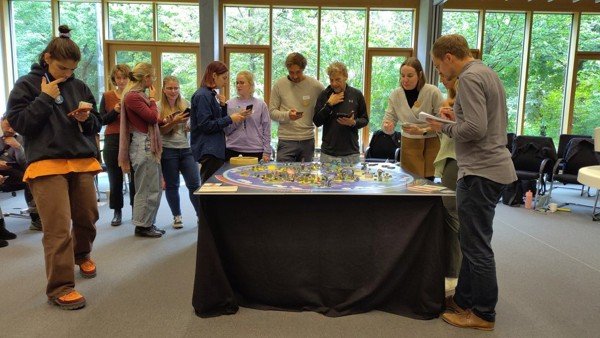
After the Center for Climate Resilience hosted the first World Climate Game in Germany in September 2024, the format was incorporated into university coursework. From March 10 to 14, 2025, it took place for the first time as a joint interdisciplinary block seminar at the Center for Climate Resilience. Thirty-six students from the fields of political science, economics, and geography participated.
The seminar was led by Prof. Dr. Angela Oels from the Department of Political Science (specializing in climate policy), Dr. Patrick Hoffmann from the Department of Environmental Economics, and Rouven Kaiser from the Department of Urban Climate Resilience. At the start of the event, participants discussed relevant theories and concepts from the three disciplines. This laid the academic foundation for the simulation experience. Following the simulation, decisions, conflicts, and outcomes were analyzed from various interdisciplinary perspectives.
During the game phase, the students acted as political, economic, or civil society actors in interdisciplinary teams. They had to evaluate information, form alliances, represent interests, and deal with both the intended and unintended consequences of their decisions. It is precisely this combination of academic preparation, active simulation, and joint evaluation that constitutes the seminar’s particular strength.
Learning Through Decision-Making
The World Climate Game offers a shared experience that serves as an empirical basis for scientific reflection. Interdependencies, conflicting goals, and power dynamics can be experienced in the game and explained through scientific theories.
Whether players act on behalf of political institutions, economic actors, or civil society organizations, they experience how strongly their own role influences the perception of a problem. Measures that seem sensible from one perspective can create new burdens elsewhere. At the same time, it becomes clear that global challenges can hardly be overcome without cooperation.
In this way, serious games can make the climate crisis tangible. In addition to imparting subject-matter knowledge, they foster critical thinking, empathy, a shift in perspective, cooperation, and negotiation skills. The subsequent reflection is central to this process: only by combining experience and theory does the game become a scientific learning space.
A Bridge Between Science and Practice
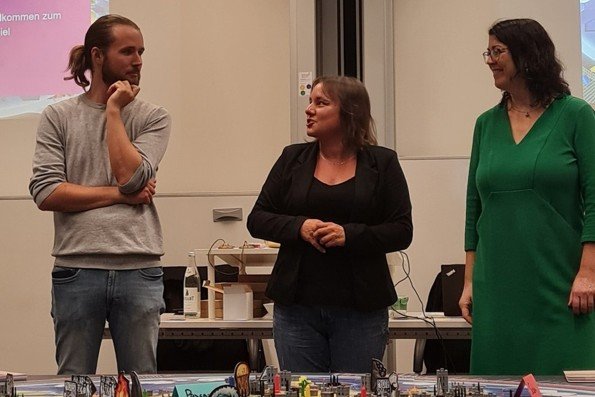
The seminar also fosters connections beyond the university. During a later session, Augsburg’s then-Deputy Mayor Martina Wild participated as a guest in the World Climate Game and brought the perspective of local politics into the discussions. She described the format as a “valuable bridge between science, education, and practice.”
The exchange highlighted that global climate policy and local action cannot be separated from one another. Decisions made at the international level shape the options for action at the local level; at the same time, it is in cities and municipalities that decisions are made regarding how climate protection and climate adaptation are concretely implemented and supported by society.
Research, Impact, and Knowledge Transfer
The findings are intended to contribute to the further development of interactive teaching, research, and participatory formats. Target audiences include schools, other universities, government agencies, and businesses. In this way, the project combines methodological research with the goal of supporting climate-conscious and forward-looking action in various sectors of society.
In 2025, Rouven Kaiser was honored with a Best Paper Award at the International Simulation and Gaming Association conference for a study on the impact of interactive climate simulations. The study, which involved more than 700 participants, concluded that this format not only aids in understanding complex interrelationships but can also strengthen skills such as cooperation, perspective-taking, and negotiation.
More About the “Serious Games” Research Project | More about the 2025 Best Paper Award
A Laboratory for Collaborative Action
In this way, the seminar becomes a laboratory for climate resilience. It demonstrates that sustainable solutions can emerge where different disciplines, experiences, and societal perspectives come together—and where knowledge is not merely imparted, but jointly applied, negotiated, and reflected upon.
Quellen und weiterführende Links
1.
Das Weltklimaspiel am Zentrum für Klimaresilienz im Blockseminar vom 10. bis 14. März 2025
2.
Zentrum für Klimaresilienz führt erstes Weltklimaspiel in Deutschland durch - Erste Durchführung im September 2024
3.
Serious Games als Werkzeuge für partizipative Stadtentwicklung - Projektbeschreibung, Spielstruktur, Ziele und Transfer
4.
Wissenschaft trifft Stadtpolitik - Besuch der Zweiten Bürgermeisterin Martina Wild beim Weltklimaspiel
5.
ISAGA Konferenz 2025: Best Paper Award für Beitrag zur Klimasimulation - Auszeichnung und empirische Untersuchung zur Wirkung des Formats
6.
In drei Tagen die Welt retten – Beitrag der Süddeutschen Zeitung zum Seminar
Kontakt
- Phone: +49 821 598-4864
- Phone: +49 821 598 4842