
Climate-neutral energy landscapes
Germany has committed to becoming climate-neutral by 2045. This goal requires a radical transformation of the energy sector, with a particular focus on significantly expanding wind and solar (PV) energy. However, this expansion faces considerable challenges. These include competing land-use demands from nature conservation, species protection, forestry, and agriculture, as well as legal setback regulations that limit the availability of suitable sites. At the same time, there is a profound change in the landscape, which can lead to additional social tensions.
Two recent studies by the University of Augsburg use the Allgäu planning region and the Cologne administrative district as examples to demonstrate how a regional energy transition in the electricity sector can be implemented in practice to align with the goals of the Paris Agreement. However, the two studies also show that a climate-neutral electricity supply in densely populated regions of Germany would only be possible through energy-saving measures. The two regions differ both in terms of meteorological factors such as wind speed and solar radiation, as well as in their population structure, economic profile, landscape characteristics, and legal frameworks. This makes them ideal case studies for assessing regional differences in the potential for climate-neutral electricity generation and the associated landscape changes. The studies provide concrete data for policymakers and planners to minimize conflicts over land allocation and to strengthen social acceptance and ecological sustainability.
Key findings
The study on the Allgäu region shows:
-
Climate-neutral electricity generation is technically and spatially feasible in the Allgäu region.
-
Current planning regulations primarily hinder wind energy, while sufficient land is available for ground-mounted PV systems.
-
Changes to planning laws can significantly increase or decrease the available land for renewable energy (RE).
-
PV is the key: The potential is so great that, in all scenarios considered in the study, PV can fill gaps in wind energy supply with wind energy.
-
Wind energy alone is not enough to achieve the goals by 2045.
-
The high potential of renewable energy facilities in the Allgäu region can make a significant contribution to Germany’s climate neutrality.
-
Die Energiewende verändert die Landschaft massiv – je nach Szenario in unterschiedlichem Ausmaß.
The study for the Cologne administrative district shows:
-
Climate-neutral electricity generation in the region cannot be achieved under current planning conditions.
-
There is not enough land available for renewable energy facilities.
-
Only a significant reduction in energy demand—on the order of 50%—would make it possible to achieve the goals.
-
Even under these conditions, the energy transition would entail a massive impact on the landscape.
-
Targeted measures could nevertheless significantly increase the share of renewable energy.
methodological innovation
To date, there has been no spatial planning concept to support Germany’s ambitions. Land scarcity and land-use restrictions (e.g., for recreational areas, nature conservation, and distance requirements from residential areas) are hindering the necessary expansion. An explicit method for the optimal siting of renewable energy facilities that is consistent with both the Paris Agreement and existing planning regulations has not yet been developed. The climate targets of previous governments have never been systematically reconciled with spatial restrictions. There is also a lack of empirical data on:
- the actual land requirements for a complete energy transition,
- the availability of suitable land under current law,
- possible site options for renewable energy facilities.
One of the key innovations of these studies is the selection of sites for renewable energy in line with the Paris Agreement climate goals. The combination of a geographic information system (GIS)-based approach and a precise site-selection algorithm (resolution: 100 meters) enables realistic modeling of energy landscapes while taking spatial constraints into account. The algorithm ensures that the distribution of renewable energy facilities complies with legal regulations and minimizes land-use conflicts. It places individual wind turbines with their actual dimensions and spacing rules, thereby enabling significantly higher spatial precision than previous approaches. Using these innovative tools, various planning scenarios and the resulting energy landscapes were outlined (Fig. 1)—ranging from the status quo to scenarios with varying levels of nature conservation and modified spacing regulations. Additionally, technological progress and potential changes in energy demand are taken into account.
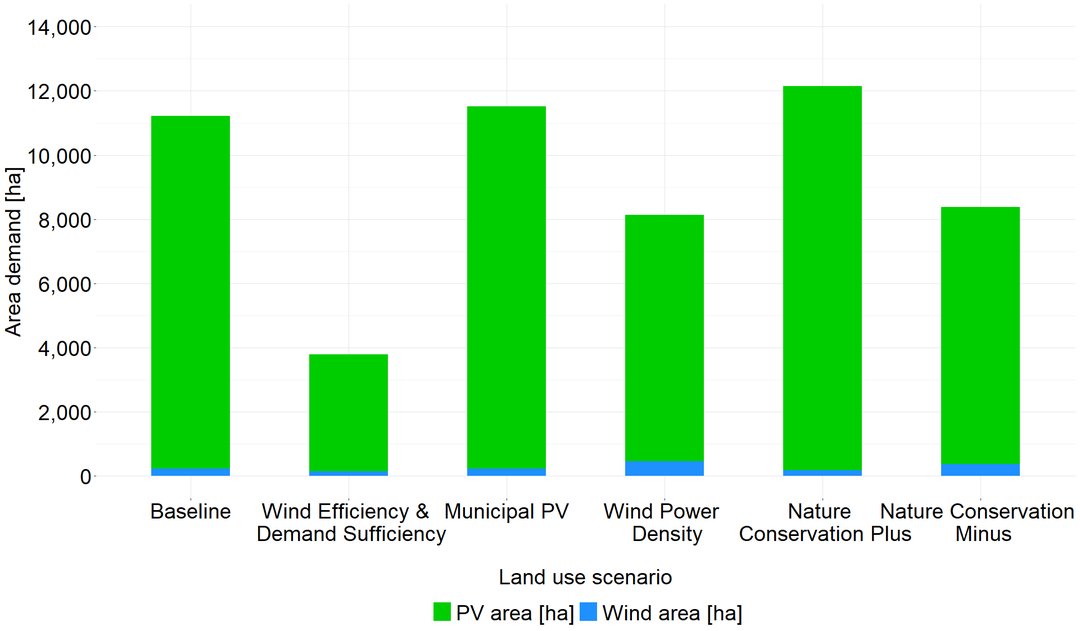
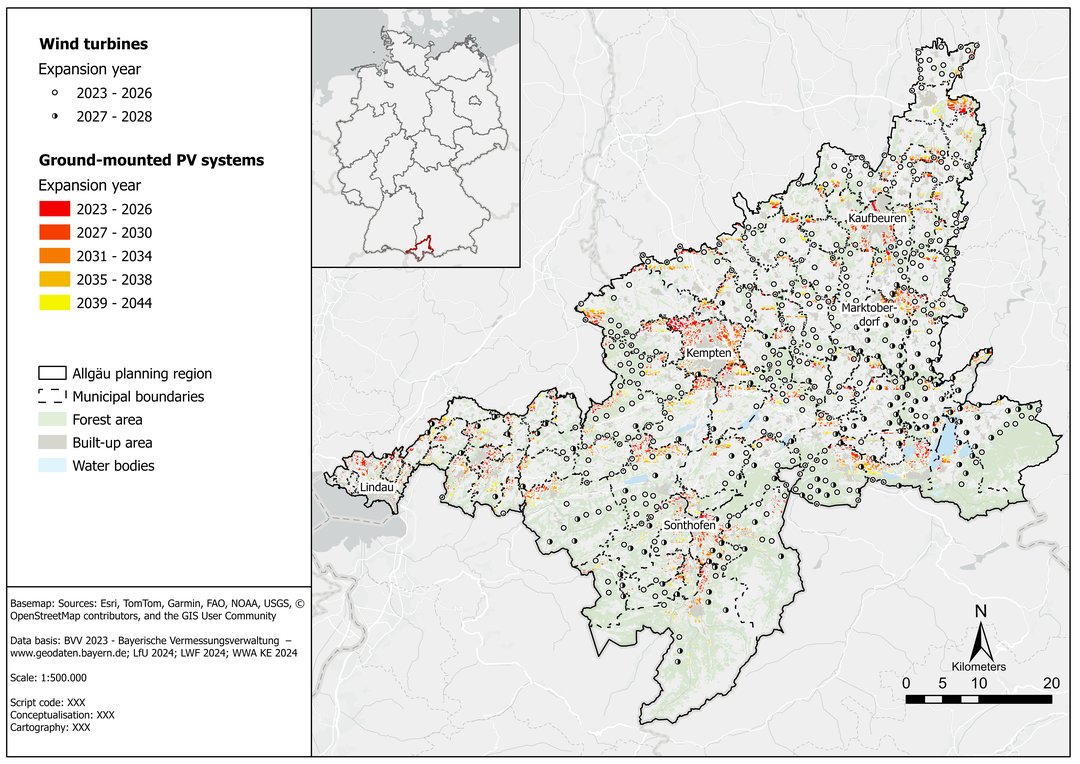
Abb. 1. Je nach Szenario unterscheiden sich die Flächenbedarfe insbesondere für PV-Anlagen in der Planungsregion Allgäu mitunter erheblich. Die Ausweitung des Naturschutzes „Nature Conservation Plus“ hätte den höchsten Flächenbedarf zur Folge, da zusätzliche PV-Anlagen erforderlich wären (siehe linke Seite). Das städtische Umland bietet sich dabei besonders für PV-Flächen an, während insbesondere das Ostallgäu ein idealer Standort für zukünftige Windkraftanlagen ist. Das Szenario „Municipal PV“ würde eine räumlich besonders gerechte, kommunale Verteilung der Anlagen bedeuten (siehe rechte Seite). Weitere Szenarien werden unter Abb. 2 beschrieben.
The studies conclude
The study’s findings offer policy makers and local governments options for action to minimize conflicts over land allocation and increase acceptance of renewable energy. The methodology could be applied to other regions or even entire countries in the future—provided that reliable data is available. By analyzing the socio-technical impacts and examining the interactions between technology, people, and the environment, it is possible to demonstrate how adaptable planning laws and innovative technologies can shape future energy landscapes. Corresponding conclusions regarding the extent to which people and nature will be affected and where potential areas of conflict between society, nature, and land use may arise provide important decision-making support for policymakers. In all climate-neutrality scenarios, for example, at least 50% of wind turbines would be located on forested areas, while PV systems would be installed almost exclusively on agricultural land and only a fraction on conversion sites (e.g., on rooftops or industrial sites).
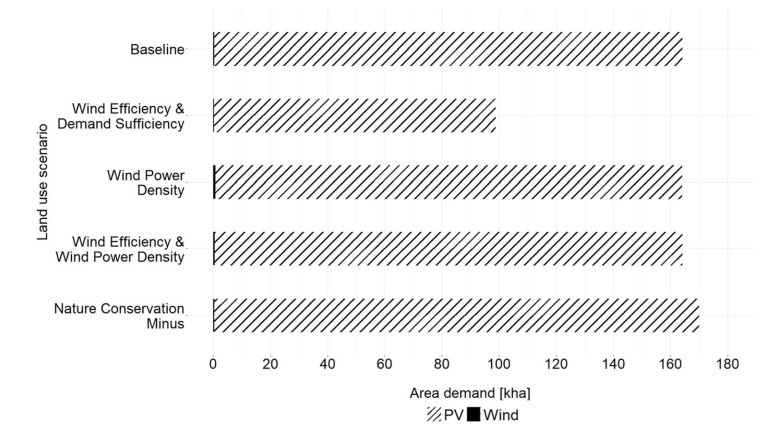
Using the Allgäu planning region as an example, the authors demonstrate that the energy transition is technically feasible, although planning regulations and land availability are critical factors. However, it also becomes clear that densely populated regions, such as the Cologne administrative district, cannot meet their own demand for climate-neutral energy without reducing their energy consumption or sourcing climate-neutral electricity from other regions. Even though Germany’s land area consists largely of cultivated landscapes, the energy transition entails not only a socio-ecological transformation but also a transformation of land use and the landscape (Fig. 2). Without greater use of landscape-defining PV, climate targets will be virtually unattainable. This highlights how important smart planning is for the coming years and that lawmakers must finally engage in systematic spatial planning.
Limitations of the studies:
Key factors in the expansion of renewable energy include increasing storage capacity, enabling parallel land use (e.g., wind turbines on farmland or agri-PV), and rapid grid expansion. Since these factors could not be taken into account in the current study, the results are naturally subject to a certain degree of uncertainty, as is also the case with future policy decisions. Nevertheless, the core findings of the studies remain unaffected.
citation and contact
- Phone: +49 821 598 2744
- Email: dragan.petrovic@uni-auni-a.de ()
- Room 2023 (Building B)
Petrovic, D., Schrade, F., Bosch, S., and Kunstmann, H.: Too little space for renewables? Modeling carbon-neutral energy futures in southern Germany, Applied Geography, 103977, 2026.
Petrovic, D., Schrade, F., Bosch, S., and Kunstmann, H.: Mapping renewable energy futures in the Cologne planning region: Land-use constraints and landscape impacts, Environmental Management, 6, 2026.
Funding:
This research was funded by the German Research Foundation (DFG) [Grant Number 509460539].
Statement:
The results of both studies make it clear that the energy transition is not merely a technical challenge, but also depends significantly on regional land availability, planning frameworks, and public acceptance. Predominantly rural regions such as the Allgäu generally offer good conditions for a climate-neutral electricity supply, while highly urbanized areas such as the Cologne administrative district highlight the limits of regional energy self-sufficiency. This makes it clear that designing future energy landscapes requires differentiated, region-specific strategies to reconcile climate goals, nature conservation, and societal demands.