
News
PhD student (m/f/d), Faculty of Mathematics, Natural Sciences and Technology
Institute of Physics, Chair of Experimental Physics I (Prof. Dr. Jan Lipfert)
Application deadline: July 15th, 2025
CHE ranking: good rating for physics and mathematics master's degree programs
The Faculty of Mathematics, Natural Sciences and Technology at the University of Augsburg can draw a positive balance: Its Master's degree courses in Mathematics and Physics have achieved excellent results in the new CHE University Ranking 2024. This nationwide comparison of degree courses and study conditions was published by the Center for Higher Education Development (CHE) in mid-December.


A Simple Method to Transform Soft Magnets into Hard Magnets
A team of researchers at the University of Augsburg has discovered a groundbreaking method to turn a soft magnet into a hard one using nothing more than moderate uniaxial stress - pressure applied in a single direction. Their findings were recently published in the prestigious journal Physical Review Letters.

Machine learning solves complex quantum problems
Due to a new method, artificial neural networks, as used in machine learning, will be able to be trained quicker so as to be able to solve complex problems in quantum mechanics. For example, previously unexplained properties of a special state of matter, the quantum spin liquid, can be calculated, something that has not been possible with any previous method to date. This has been made possible by a new optimisation method developed by the Institute of Physics.
Praise for Augsburg’s bachelor’s degree programmes by CHE Ranking

How life began: A molecular perspective

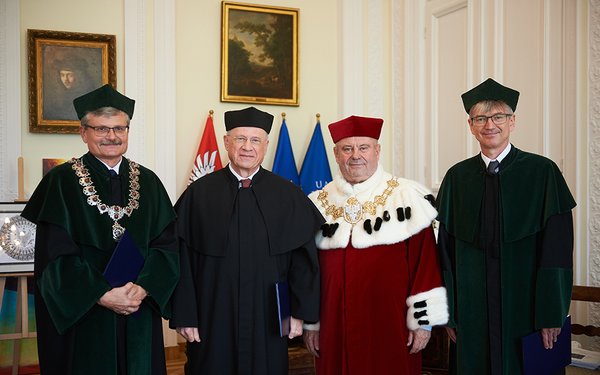
Honorary doctorate for Prof. Dieter Vollhardt
Prof. Dieter Vollhardt was awarded an honorary doctorate by the University of Warsaw last week in recognition of his scientific achievements and longstanding collaboration with theoretical physicists at the University of Warsaw.
New measuring device should improve the development of vaccines

New Alexander von Humboldt Fellow at the University of Augsburg
Dr. Alexander Khort, a chemical engineer from the Royal Institute of Technology (KTH) Stockholm, is a new researcher at the Faculty of Mathematics, Natural Sciences and Technology at the University of Augsburg for two years. There he is working together with Prof. Dr.-Ing. Suelen Barg on developing new methods for producing smart nanomaterials, investigating their properties, and possible applications, and studying degradation behaviour.

Hall-effect uncovers hidden symmetry in spin-ice
Physicists from the University of Augsburg succeeded to distinguish chiral orders with similar magnetization but opposite sense of rotation through electrical measurements at low temperatures. This is relevant for fundamental research on complex magnets and with respect to possible applications for magnetic data storage. The results were published in the renowned journal Nature Physics.

Discovery of high order skyrmions and antiskyrmions
Researchers at the University of Augsburg and the University of Vienna have discovered co-existing magnetic skyrmions and antiskyrmions of arbitrary topological charge at room temperature in magnetic Co/Ni multilayer thin films. Their findings have been published in the renowned journal Nature Physics and open up the possibility for a new paradigm in skyrmionics research. The discovery of novel spin objects with arbitrary topological charge promises to contribute to advances in fundamental and applied research, particularly through their application in information storage devices.
